



TEMPLES & SACRED PLACES · EGYPT
Between Shadows and Eternity
Exploring Saqqara beyond the pyramids
Saqqara · Old Kingdom · Pyramid Texts · Serapeum · Djoser · Nobles' Tombs · Imhotep
Thirty kilometres south of Cairo, at the western edge of the desert where the green of the Nile valley gives way abruptly to sand, one of the oldest and least understood necropoles in the world unfolds. Saqqara is not a temple or a pyramid: it is a city of the dead nearly seven kilometres long, active for more than three thousand years. The Step Pyramid of Djoser — the oldest pyramid in the world, built around 2650 BC — is its most recognisable image. But Saqqara is, in reality, dozens of places within a place, each with its own history, its own depth and its own silence. This article is dedicated to those that most visitors never see.
I. Imhotep and the birth of stone architecture
To understand Saqqara one must begin with the man who transformed it: Imhotep, the architect of Pharaoh Djoser of the 3rd Dynasty, around 2650 BC. Imhotep was not merely a builder: he was the first architect in history whose name we know, the first documented physician, the first recorded astronomer, and — centuries after his death — the only non-royal human being that the Egyptians elevated to divine status. The Greeks identified him with Asclepius, their god of medicine. His technical achievement was revolutionary: before Imhotep, the Egyptians built in wood, reed and mud brick. The Step Pyramid was the first great structure in history built entirely in stone.
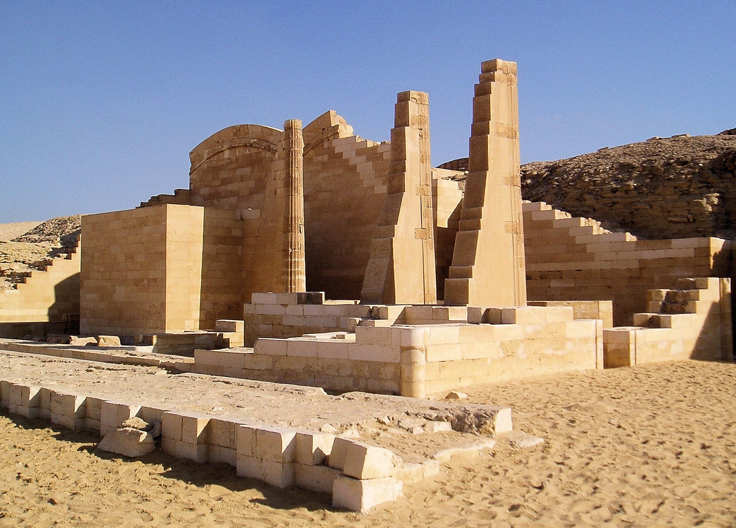
The funerary complex surrounding the pyramid is, in itself, one of the most extraordinary architectural ensembles in Egypt: a walled precinct nearly 550 metres long that includes ceremonial courts, chapels, hypostyle halls and a series of structures designed for eternity but built in stone imitating wood and reeds, as if the architect wanted to perpetuate in stone the aesthetic of a world already being superseded by his own.
"Imhotep did not build a tomb. He built the first prototype of the ordered universe: a cosmos of stone in which the pharaoh could live for ever under the gaze of the gods."
II. The Pyramid Texts: the oldest religious corpus in the world
At the southern end of the Saqqara plateau, far from the standard tourist circuits, stand the pyramids of the 5th and 6th Dynasties: smaller structures than those of Giza, but ones that house in their funerary chambers the oldest textual treasure humanity has produced. The Pyramid Texts — inscribed on the walls of the pyramids of Unas, Teti, Pepi I, Merenra and Pepi II — constitute the first systematic religious corpus in history, earlier by centuries than the Vedic texts and the Book of the Dead.
The texts describe the deceased pharaoh's journey from death to resurrection: the protective formulae against the creatures of the underworld, the names of the gods guiding the soul at each threshold, the prayers for opening the celestial gates. They are functional texts, not decorative: each spell was placed on the precise wall where the pharaoh's soul would need it.
The pyramid of Unas is the most accessible and best preserved of those bearing texts. The lapis lazuli blue of the hieroglyphs on a white background, lit by torchlight in the darkness of the chamber, is one of the most visually striking experiences in all of Egypt. And the sensation of reading words written four thousand three hundred years ago for a divine human being to navigate the darkness of the afterlife carries a weight that no description can adequately prepare one for.
Saqqara's treasures off the standard circuit
The Serapeum — the chambers of the sacred bulls — Excavated in 1851 by Auguste Mariette, it is an underground labyrinth of galleries extending more than 300 metres beneath the desert sand. Its chambers hold the monolithic granite sarcophagi of the Apis bulls, physical manifestations of the god Ptah. Each sarcophagus weighs between 60 and 70 tonnes and is carved from a single piece of black Aswan granite. How they were introduced into tunnels that barely exceed their dimensions has no fully satisfactory answer.
The tomb of Ti — the finest relief of the Old Kingdom — A senior official of the 5th Dynasty whose tomb, discovered intact in 1865, contains some of the most vivid reliefs in pharaonic art. The scenes of daily life — marshland hunts, musicians' processions, agricultural scenes — have a narrative quality contrasting with the hieratic solemnity of the better-known temples.
The tomb of Mereruka — the largest of the nobles' tombs — With more than 30 decorated chambers, the tomb of Vizier Mereruka is the largest private tomb in the Saqqara necropolis. His chapel-statue emerging from the wall as if crossing the threshold between worlds is one of the most powerful moments in Egyptian funerary art.
North Saqqara — the recently opened tombs — Since 2018, recent excavations have revealed priests' and officials' tombs from the New Kingdom with perfectly preserved mummies, vividly polychrome sarcophagi and a mummification workshop shedding new light on embalming rituals.
III. The Serapeum: where scale defies understanding
What Mariette found beneath the sand in 1851 exceeded any expectation: side chambers carved in rock, each containing a monolithic black granite sarcophagus. The sarcophagi measure approximately four metres long, two wide and two high. They weigh between sixty and seventy tonnes each. And they are empty: the Apis bull mummies had been plundered in antiquity.
The question that engineers and archaeologists have not been able to answer satisfactorily is simple: how did they get in? The Serapeum tunnels have a width and height barely exceeding the dimensions of the sarcophagi. Moving them to their current position — in antiquity, without modern technology — would require a logistics that archaeologists have postulated but not fully demonstrated. The Serapeum shares with the Osireion that unsettling quality: the sense that something does not quite fit in the narrative we know.
"In the Serapeum, the scale does not impress: it disconcerts. Not because the sarcophagi are large, but because their presence in that specific place raises questions that conventional archaeology has not yet fully answered."
IV. The pyramid of Djoser from within: the labyrinth under the earth
Beneath the Step Pyramid extends a labyrinth of more than five kilometres of underground galleries and chambers, carved in the rock to house the pharaoh and his closest family in the afterlife. The central funerary chamber, lined with Aswan granite at a depth of twenty-eight metres, contained Djoser's remains in an alabaster sarcophagus. The side galleries held thousands of stone vessels placed there to guarantee symbolic abundance in the afterlife.
Access to the underground galleries is not part of the standard tourist route. It requires a specific permit and a specialist guide. The experience of descending those four thousand six hundred year-old corridors, with the limestone walls glittering in the torchlight and the weight of time becoming physical in the narrowness of the space, is something no other place in Egypt can replicate.
V. How to visit Saqqara well
Saqqara suffers from an image problem: it is perceived as the place one visits en route between Cairo and Giza. Nothing could be further from the truth. A well-designed visit can comfortably occupy a full day, and each additional hour adds layers of understanding and sensory experience that a quick visit cannot provide.
The order we recommend: begin with the Djoser complex at first light, when the low dawn light illuminates the chapel facades with a quality that disappears by nine o'clock. Continue to the Serapeum before the groups arrive. Spend the afternoon in the nobles' tombs — Ti, Mereruka, Kagemni — in the interior half-light, where reliefs read better by torchlight than in natural light. Reserve the visit to the Unas pyramid for day's end, when the underground galleries are in complete silence.
Practical visit details
LOCATION: 30 km south of Cairo. 45–60 min by private car from the city.
RECOMMENDED DURATION: Minimum 4 hours for the essentials. Full day for an in-depth visit.
SPECIALIST GUIDE: Essential. The nobles' tombs lack explanatory signage.
TORCH: Essential for the Serapeum and tombs with interior reliefs.
RECOMMENDED COMBINATION: Saqqara + Dahshur (Red Pyramid and Bent Pyramid) in the same day.
VI. Why Saqqara matters more than it seems
Saqqara is the place where Ancient Egypt invented stone as a material of eternity. The place where the words the dead would need to survive the afterlife were written for the first time. The place where an official named Ti left on his walls a portrait of daily life in the third millennium BC so vivid that four thousand years suddenly seem manageable. And the place where, beneath the sand, seventy-tonne sarcophagi rest whose presence no one has fully explained.
The traveller who arrives at Saqqara with a full day, a specialist guide and a charged torch will not leave disappointed. They will leave convinced of having found one of the most extraordinary places that Egypt — and the world — has to offer.
— ✦ —
"Saqqara is not the place where Ancient Egypt begins. It is the place where Ancient Egypt learned to speak to eternity."
To include Saqqara in depth in your Egyptian programme, with access to the Serapeum and the nobles' tombs, contact our team.