



HISTORY & CULTURE · ANCIENT EGYPT
The Secret Language of Hieroglyphs
How to read the sacred walls
Hieroglyphs · Sacred Writing · Champollion · Temples · Rosetta Stone · Pharaonic Culture
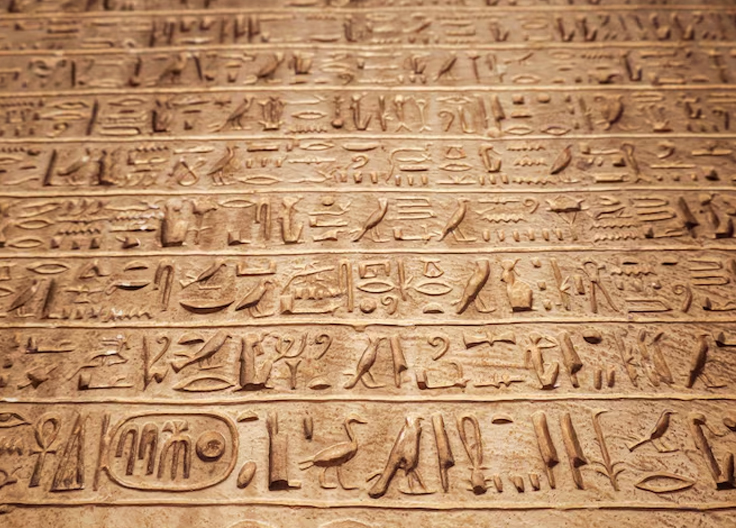
Imagine stopping before the inner wall of the temple of Karnak and, instead of seeing a succession of beautiful and indecipherable symbols, beginning to recognise words. A falcon with a solar disc: Ra, the supreme god. A closed oval with signs inside: the pharaoh's cartouche, his eternal name. A seated figure with hand to mouth: the determinative of silence, of the sacred, of that which must not be spoken aloud. In that moment, the temple ceases to be decoration and becomes a text. And Egypt, suddenly, begins to speak.
I. Medu netjer: the words of the gods
The ancient Egyptians called their writing medu netjer, usually translated as 'words of the gods' or 'divine writing'. It was not a metaphor. For them, hieroglyphs were not simply a communication system: they were a magical tool. To write the name of a god was, in some sense, to invoke it. To inscribe the pharaoh's name on the walls of a temple was to guarantee his existence beyond death. To erase a name — as Thutmose III did with Hatshepsut's inscriptions, or as the priests of Amun did with the name of the heretic pharaoh Akhenaten — was equivalent to annihilating that person's soul, to erasing them from the universe.
This conviction explains why hieroglyphs are so abundant in Egyptian temples and tombs, and why their execution was always so meticulous. Each sign was, literally, a living entity. The scribes who carved funerary reliefs even took the precaution of mutilating hieroglyphs representing dangerous animals — serpents, lions, crocodiles — so they could cause no harm in the afterlife. Writing did not represent reality: it was part of it.
"For the Egyptians, writing was not about recording the world. It was about creating it. Every sign carved in stone was an act of generation, a small victory over chaos and forgetting."
II. Fifteen centuries of silence: how the key was lost
The hieroglyphic system was in use for more than three thousand years, from approximately 3200 BC to the 4th century AD. The last known hieroglyph was inscribed on 24 August 394 AD at the temple of Philae in Aswan — the same temple visited today on its relocated island after the UNESCO rescue. Afterwards, knowledge of the sacred writing vanished with astonishing rapidity. The rise of Christianity, and subsequently of Islam, led to pharaonic temples being closed or transformed, and with them disappeared the caste of priest-scribes who transmitted the knowledge.
For fifteen centuries, hieroglyphs were an absolute enigma. Medieval and Renaissance travellers who visited Egypt contemplated them with a mixture of fascination and bewilderment, convinced that each sign was a mystical symbol with a profound, hidden meaning — an interpretation that, paradoxically, was not so far from the truth, though for different reasons than they imagined.
The discovery that changed everything came accidentally, as great findings usually do. In 1799, during Napoleon's Egyptian campaign, a French officer named Pierre-François Bouchard found in the locality of Rashid — which Europeans would come to know as Rosetta — a black granite stone inscribed with the same text in three different scripts: hieroglyphic, demotic and Greek. Someone, in the 2nd century BC, had thought to draft a royal decree in the three administrative languages of Ptolemaic Egypt. Without knowing it, they had left the key to the greatest linguistic enigma in history.
III. Champollion and the decipherment: a story of obsession
Jean-François Champollion was eleven years old when he first saw a copy of the Rosetta Stone texts. At thirteen he publicly declared that he would be the one to decipher them. He did so twenty-two years later, on 14 September 1822, in a letter to the Académie des Inscriptions et Belles-Lettres in Paris that would go down in history as the lettre à M. Dacier. By his own account, on finishing writing it he collapsed and did not regain consciousness for five days.
Champollion's brilliant intuition — which his contemporaries were slow to accept — was to understand that hieroglyphs were not a purely symbolic or ideographic system, but a mixed script: some signs represented sounds (phonograms), others represented ideas or concepts (ideograms or logograms), and others served as silent determinatives that clarified the meaning of words without adding any sound. This layered combination makes hieroglyphs one of the most sophisticated writing systems ever developed, and explains why their decipherment took centuries.
The three types of hieroglyphic signs
— Phonogram: Represents one or more sounds, like letters in an alphabet. Can be uniliteral (one consonant), biliteral (two) or triliteral (three).
— Logogram: Represents an object or concept directly. The solar disc is Ra. The sistrum is Hathor. The djed pillar is Osiris. The image is the word.
— Determinative: A silent sign added at the end of a word to specify its semantic category without contributing any sound to the pronunciation.
— Royal cartouche: The elongated oval with a horizontal base enclosing the pharaoh's name. A rope surrounding and protecting the eternal identity of the king.
IV. Navigating a wall of hieroglyphs
One of the most elegant particularities of hieroglyphic writing is that it can be read in three directions: right to left, left to right, or in vertical columns from top to bottom. The key to knowing where to begin is simple and beautiful: signs representing human figures or animals always face towards the beginning of the line. If birds and human figures face right, read from right to left. If they face left, read in that direction. The writing, literally, indicates its own starting point.
In temples, walls are typically organised in horizontal registers read from top to bottom, and vertical columns flanking the main scenes. The longest inscriptions — such as the Pyramid Texts at Saqqara or the Coffin Texts of the Middle Kingdom — form genuine theological treatises that priest-scribes knew by heart and that Egyptologists continue to decipher in their full depth today.
A detail that transforms any temple visit: the royal cartouches. That elongated oval with a horizontal base repeated endlessly on walls, columns and lintels contains the name of the pharaoh who commissioned or decorated that space. Learning to recognise the cartouches of Ramesses II, Thutmose III or Hatshepsut turns every wall into a signature, a claim of authorship over stone and eternity.
"Hieroglyphs do not decorate temples. Temples are the support on which hieroglyphs do their work: naming, invoking, protecting, perpetuating."
V. Concepts with no exact translation
One of the most revealing experiences offered by a basic study of hieroglyphs is encountering concepts for which English — or any modern language — has no precise equivalent. Ancient Egyptian thought operated with categories reflecting a radically different cosmology, and some deserve to be lingered over.
Untranslatable concepts from Ancient Egypt
Ka — The vital force animating the living being during its existence. Not exactly the 'soul', but the creative energy transmitted by gods and ancestors. At death, the Ka remained linked to the body — the reason why mummification was indispensable.
Ba — The individualised personality of a human being, what makes each person unique and irreplaceable. Represented as a bird with a human head. After death, the Ba could move freely between the world of the living and the afterlife.
Maat — The cosmic principle of order, truth, justice and balance. It was simultaneously an abstract concept and a goddess. The pharaoh ruled 'in accordance with Maat', and the soul of the deceased was weighed against Maat's feather in the judgement of the afterlife.
Duat — The Egyptian underworld: not a place of punishment but a space of transformation through which the sun travelled each night and the deceased transited towards resurrection. A territory as real and mapped as Egypt itself.
Ren — One's proper name, conceived as a constituent part of the self. As long as someone's name was spoken or inscribed, that person continued to exist. This is why erasing an enemy's name was, for the Egyptians, the ultimate act of violence.
VI. Reading the walls: what changes when you know how to look
It is not necessary to master hieroglyphs for a basic knowledge of their logic to completely transform the experience of visiting an Egyptian temple. With a few tools — recognising the royal cartouche, identifying the major gods by their attributes, understanding the direction of reading, knowing what a determinative is — the visit becomes something else entirely.
In the temple of Abydos, the most sacred of all Upper Egyptian sanctuaries, a long gallery houses the Royal List of Seti I: a sequence of 76 cartouches recording the names of the pharaohs recognised as legitimate, from Menes, the first unified king of Egypt, to Seti himself. It is one of the most important historical documents of Antiquity, and to walk through it in silence, recognising some names, knowing that each oval enclosed the eternal identity of a being who believed that sign would protect him for ever, carries an emotional weight that no conventional guide can convey.
In the Valley of the Kings, the tomb walls are covered with texts from the Book of the Dead, the Amduat and other funerary writings that describe, with cartographic precision, the nocturnal journey of the soul through the underworld. They are texts meant to be read in darkness, by torchlight, with the same quality of inner attention we now call meditation.
— ✦ —
"Hieroglyphs have been carved in stone for three thousand years, waiting for someone to pause long enough to listen to them."
To discover the temples of Egypt with a specialist Egyptologist who turns every wall into a reading, contact our team and we will design your programme.