



EXCLUSIVE EXPERIENCES · EGYPT
Photography in Egypt
Capturing the perfect light in unique locations
Photography · Golden Light · Private Access · Karnak · Nile · Desert · Photography Journey
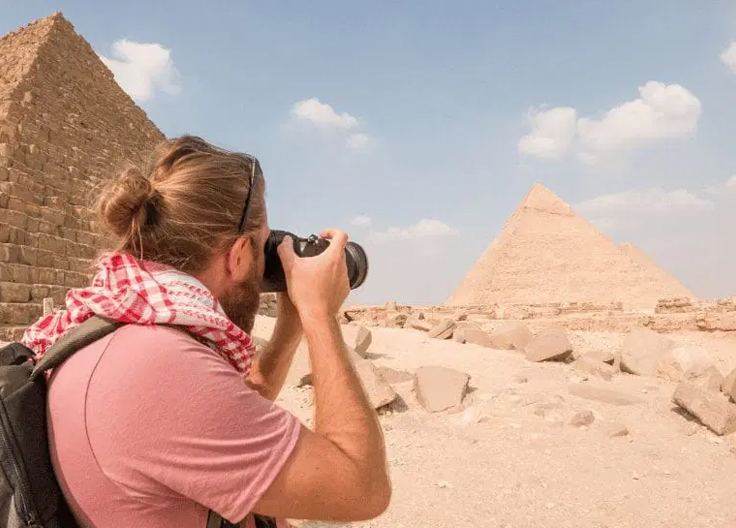
Egypt is one of the most extraordinary photographic destinations in the world and, paradoxically, one of the most difficult to photograph well. Not for lack of material — every kilometre of the country offers potentially memorable images — but because the photographs most travellers bring home are the same ones found in thousands of albums and guidebook covers: the standard angle, the midday light, the pyramids with coaches in the background. Photography as personal authorship in Egypt requires something else: time, access, knowledge of the territory and the understanding that in this country, light is everything.
I. Egyptian light: a phenomenon in its own right
The light in Upper Egypt has qualities that photographers who have worked with it describe, almost without exception, as unique. Its latitude — Luxor is at 25 degrees north, comparable to Florida or Shanghai — combined with the absolute dryness of the desert air produces a type of light that does not exist in Europe or most of North America: horizontal and intense in the hours of dawn and dusk, white and almost metallic at the summer zenith, warm to a deep orange in winter sunrises and sunsets.
The honey-coloured sandstone of the temples of Luxor, Karnak, Edfu and Kom Ombo interacts with that light in a way that makes the same building seem completely different at different times of day. At six in the morning, when the light enters low and oblique between the columns of Karnak's hypostyle hall, the reliefs acquire a three-dimensionality and depth of shadow that disappears completely two hours later. At six in the evening, at the Luxor Temple, the sandstone ignites in a tone between amber and copper that no photographic filter can artificially create, because it is the stone itself that emits, not merely reflects.
Understanding that behaviour of the light — and designing access to photographic locations accordingly — is the difference between bringing home a series of tourist snapshots and bringing home a genuine photographic body of work.
"Photography in Egypt does not depend on equipment. It depends on being in the right place when the light does what it knows how to do. And that is planned, not improvised."
II. Photographic locations: where and when
There is a selection of places in Egypt that offer, in the right conditions of light and access, photographic possibilities of exceptional quality. What distinguishes them from the standard tourist circuit is not their historical importance — many are among the most visited in the country — but the time of day at which they are visited and the absence of groups competing for the same frame.
The locations and their optimal time
Karnak hypostyle hall · Dawn · 5:30–7:00h — 134 columns up to 23 metres tall, covered in reliefs. With low, lateral light, reliefs acquire three-dimensionality and shadow depth that disappears when the sun rises. Private access before opening essential. Wide-angle 16–24mm for the colonnades.
Luxor Temple · Sunset · 17:00–18:30h — The sandstone igniting with the horizontal western light. The Ramesses colossi as silhouettes against an orange sky. 50–85mm to compress perspective and isolate relief details illuminated in raking light.
Abu Simbel · Opening · 5:00–6:30h — The four colossi in the first light, with long shadows. No groups. Lake Nasser reflecting the sky behind. Wide-angle for the full facade; 200mm+ telephoto for the detail of the colossi's faces.
Philae Temple · Private sunset by felucca — The island surrounded by water, Trajan's Kiosk columns reflected in the Nile. Access by private felucca once the groups have left. Tripod essential for long exposures with the water as mirror.
Valley of the Kings · Opening · 6:00–8:00h — Tomb facades carved in limestone, long shadows in the arid valley. Inside: the flash ban demands high ISO and fast lenses f/1.4–1.8, producing results with grain and atmosphere that artificial-light photography never achieves.
Giza plateau · 30 min before dawn — The three pyramids from the south-west angle with the city still lit below and the sky in transition. That 10–15-minute blue-hour interval is the most sought-after moment for travel photographers in all of Egypt.
III. The equipment that works in Egypt
Egypt presents specific technical challenges for photography. Desert dust is the most pervasive: it infiltrates camera and lens gaps with a persistence that surprises even photographers experienced in arid climates. Extreme summer heat can affect batteries and cause condensation on lenses when moving from air-conditioned interiors to the outside. Midday light is so intense it saturates modern sensors in automatic modes without a minimum of manual control.
Recommended kit for the photography traveller
MAIN BODY: Full-frame mirrorless with good high-ISO performance for tomb interiors without flash.
WIDE-ANGLE: 16–35mm f/2.8 or equivalent. Essential for temple interiors and colonnades.
STANDARD–TELE: 85–200mm to compress perspectives, isolate reliefs and portrait the human landscape of the Nile.
LIGHTWEIGHT TRIPOD: Essential for long exposures on the Nile at dawn, Philae and night shots in the desert.
POLARISING FILTER: For deep blue desert skies and reducing Nile reflections. Effect not reproducible in post-processing.
DUST PROTECTION: Airtight bags for lenses and neoprene covers for bodies. Egypt's dust shows no mercy.
IV. The human landscape of the Nile: portraits and everyday life
Some of the most powerful photographic work that can be brought home from Egypt is not of temples or deserts: it is of the Nile and the people who live on its banks. The fellah ploughing at dawn with an ox while the river shines behind. Women washing clothes in irrigation canals in coloured dresses against the intense green of the fields. Children on the jetties of Nubian villages with their blue and orange painted houses. The spice merchants of the Aswan market with their mounds of spices that look like a painter's pigments.
Photographing people in Egypt requires, as everywhere, respect and presence. Egyptians are generally open to the camera and tend to respond well to someone who asks permission with a smile before shooting. The local guide is invaluable in this context: they can act as cultural interpreter, explain who the photographer is and why they are interested in that moment, and create the space of trust that the most honest street photography needs.
V. Night photography: pyramids and desert under the stars
The night sky over Egypt's desert is one of the cleanest and darkest accessible from Europe. At the Giza plateau, despite the proximity of Cairo, the illuminated pyramids under a starry sky offer one of the most iconic night compositions in the world. The key is the angle: most night photographs of the pyramids are taken from the northern side. The minority — and the most interesting — are made from the desert to the south-west, with all three pyramids aligned and the Milky Way, between November and February, as backdrop.
For star photography over the desert, the Bahariya Oasis — about five hours by car from Cairo — offers a Bortle class 2 dark sky: one of the purest in North Africa. With a sand dune in the foreground and the Milky Way arching overhead, the possibilities are of a beauty that justifies the detour on its own.
Technically, night photography in Egypt requires a solid tripod, remote shutter release, ultra-fast lenses (f/1.4–2.0), ISO 3200–6400 and exposure times between 15 and 30 seconds for the Milky Way. Sand on the ground can make the tripod unstable: a hanging weight on the centre hook is essential.
VI. Designing a photography journey to Egypt: the programme that changes everything
A photography journey to Egypt is not a tourist trip to which a camera is brought along. It is an itinerary designed from scratch with light schedules as the primary variable: which location at dawn, which at mid-morning for interior architecture, which at sunset, which to reserve for night. This implies private and early access at most major monuments, a guide with photographic knowledge as well as historical, and the flexibility to adapt the plan when weather or light conditions offer something unexpected.
The photography programmes we design include: private dawn access to the Karnak hypostyle hall; visit to Luxor Temple in the last hour of light before closing; access to Abu Simbel on the first private flight of the day to arrive before official opening; photography session from a felucca on the Aswan Nile at sunset; and at least one night session on the Giza plateau or in the western desert. The accompanying photographer — available on some programmes — knows the angles, the lenses and the moments that most visitors never get to see.
Egypt is, for photography, a country of extraordinary generosity. But it only delivers its best to those who arrive willing to rise early, to wait and to understand that the best image is not the one taken: it is the one earned.
— ✦ —
"Photography in Egypt is not improvised. It is planned around the light, executed with patience and carried home as the truest memory of the journey."
To design your photography programme in Egypt with private access and optimised light schedules, contact our team.