



EXCLUSIVE EXPERIENCES · EGYPT
Sailing the Nile on a Private Dahabiya
When the world's oldest river becomes your floating home
Luxury Cruise · Nile · Private Experience · Spirituality · Upper Egypt
There are journeys that inform, and journeys that transform. Sailing the Nile aboard a private dahabiya — that wooden vessel with white sails that 19th-century travellers described as 'the most civilised way to move through time' — belongs, without question, to the second category. This is not a cruise. It is an immersion.
I. The river that invented everything
The Nile is not simply water and silt. It is the axis around which all pharaonic civilisation revolved for more than three thousand years. Its annual floods, which the ancient Egyptians called Akhet, determined the cycles of life, death and rebirth that were later projected into their theology, architecture and art. To navigate it today, at the same pace as the priests and pharaohs, is to recover a human scale that mass tourism has almost entirely erased.
Between Aswan and Luxor, along some two hundred kilometres of green riverbank and golden desert, the landscape has barely changed. The fellah still plough with wooden ploughs. Date palms lean over the water with the same grace they show in the reliefs of Karnak. And at sunset, when the sun stains the river copper and orange, it is impossible not to feel that time, here, is merely a convention.
"The dahabiya does not take you from one temple to the next. It takes you from one state of consciousness to another."
II. The dahabiya: luxury without ostentation
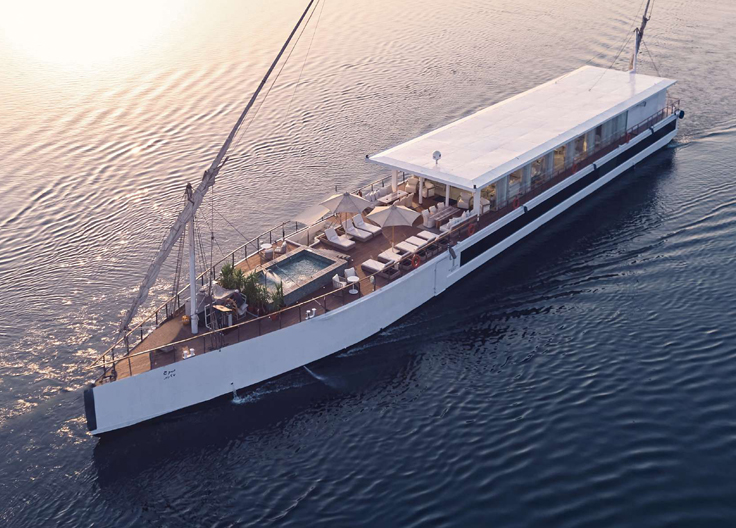
The word dahabiya comes from the Arabic dahab, meaning gold, a reference to the elaborate golden decorations that adorned royal vessels in antiquity. Contemporary luxury models — with capacity for between six and twelve guests — have reinvented that legacy with a refined and unpretentious aesthetic. Cabins with doors opening directly onto the Nile. An upper deck with low divans, linen mosquito nets and a table for dining under the stars. A private chef working with ingredients from the market of each village passed along the way.
What distinguishes the dahabiya from large package cruise ships is not merely scale or comfort, but rhythm. No fixed schedules, no guides with megaphones, no groups of eighty people queuing in the same chamber of a temple. The boat anchors when the light is perfect, and sets sail when you decide the moment has come.
Essential journey details
RECOMMENDED DURATION: 7 to 10 nights between Aswan and Luxor
EXCLUSIVE CAPACITY: 6–12 guests. Your group only
BEST SEASON: October to March — clear skies, 22–28°C
PROPULSION: Sail and silent motor. No noise, no vibration
III. Temples from the water: another way to read time
Arriving at Kom Ombo by boat, when the double temple dedicated to Sobek and Haroeris emerges from the morning mist, is an experience that no land excursion can replicate. Pharaonic architecture was conceived, in part, to be contemplated from the river. The sanctuaries were deliberately oriented towards the Nile: it was the path of the gods, the axis of the cosmos.
With a private dahabiya and an Egyptologist dedicated to your group, each visit becomes an intimate reading. At Edfu, the best-preserved Ptolemaic temple in the world, you can enter before the first excursions arrive. At the temples of Philae, relocated stone by stone to save them from the waters of Lake Nasser, the private night visit — with torches, without tourists — is one of the most silent and meaning-dense moments this country can offer.
IV. Spirituality in motion: meditation on the Nile
Some of our programmes incorporate meditation and pranayama sessions on deck at dawn, when the river still holds the silence of the night and the light is a fragile pink. This is not a decorative touch: the culture of Ancient Egypt was deeply marked by practices of inner attention, purification rituals and an understanding of the body as a vehicle of consciousness that predates other better-known traditions by centuries.
The very act of sailing slowly on a four-thousand-kilometre river activates something that is difficult to name but easy to feel. A quietening. A perspective. The inner noise that accompanied the flight to Cairo begins to dissolve, slowly, in the reflection of the water.
V. The dahabiya table: Nubian cuisine and desert hospitality
Each morning, at some riverside market known only to locals, the chef will provision the boat: pomegranates, dried dates, buffalo milk cheese, lake squid, Nile perch. The cooking on board blends Nubian tradition — with its ochre-coloured spices and thick red lentil soups — with the elegance of a beautifully laid table at sunset, when the sun falls on the dunes of the western bank and cold mint wine fills the glasses.
One evening, the boat may anchor opposite a Nubian village for dinner ashore, in a private home, with oud music and percussion, beneath a reed roof. This is not a performance for tourists: it is a genuine invitation that is only possible when you travel slowly and with the trust of those who know the territory.
— ✦ —
VI. How to plan this journey
A private dahabiya cruise is not booked like a hotel room. It requires planning months in advance, coordination with Egyptian river authorities and the careful selection of the vessel and the Egyptologist who will accompany you. Each itinerary is designed from scratch: which temples, at what time of day, with what depth of historical insight, with what space for contemplation and silence.
There are details that make the difference: a transfer from Aswan by helicopter to contemplate the Nile from the air before boarding, a visit to the Aswan spice market with a Nubian cook, a photography session at sunset from an auxiliary felucca when the light is exactly what you were looking for.
"The Nile has been waiting for you for four thousand years. Take the time to arrive as it deserves."
To discover our exclusive Nile dahabiya programmes and begin planning your experience, contact our team.