



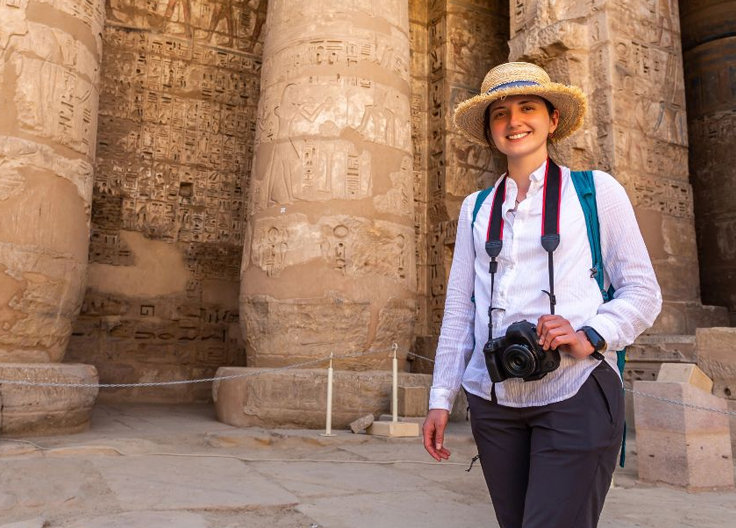
INNER JOURNEY · EGYPT
Travelling Solo to Egypt
An experience of introspection and self-discovery
Solo Travel · Introspection · Self-Discovery · Inner Journey · Private Luxury · Transformation · Consciousness
There are journeys best made in company, and journeys that can only be made alone. Egypt belongs, with surprising clarity, to both groups. But there is a dimension of this country that only reveals itself in solitude: the one that occurs when there is no one with whom to discuss what has just been seen, when the experience cannot be shared immediately and must remain inside, sedimenting, finding its place within the traveller without the mediation of words. It is in that active solitude where Egypt does its deepest work.
I. Why Egypt and solitude are natural allies
The great spiritual civilisations of history understood something that contemporary culture has partly forgotten: that the encounter with the sacred requires silence, and that true silence is only possible in solitude. The Christian desert monks who retreated to Egypt in the 3rd and 4th centuries — the so-called Desert Fathers, whose maxims are still read in contemplative traditions around the world — chose precisely Egypt as the setting for their inner practice. Not by chance. There was something in that landscape — the immensity of the desert, the stillness of the Nile, the palpable presence of what the pharaohs called eternity — that made possible a quality of attention that urban environments dissolve.
That something is still there. The solitary traveller who arrives at the Giza plateau before dawn, when the site is nearly empty and the light on the horizon begins to define the silhouettes of the pyramids against the dark sky, needs no one to explain what they are feeling. They feel it. And in the absence of someone to explain it to, that feeling deepens rather than dissipates. It becomes experience, not anecdote.
Travelling alone to Egypt is not a fallback when no travelling companion can be found. It is a deliberate choice that opens a dimension of the journey that company, however good, inevitably closes.
"Travelling alone is not travelling without company. It is travelling with the most difficult and most revealing company that exists: oneself."
II. The moments that only exist in solitude
There are certain experiences in Egypt that reach their greatest intensity when lived in solitude. Not because company ruins them — it does not — but because solitude adds a layer of presence that is difficult to describe and easy to recognise when lived.
Experiences designed for the solo traveller
Dawn on the Giza plateau — alone — Standing before the pyramids before the first groups arrive, with no one beside you to look at for confirmation of what you are feeling. The experience remains entirely within. That is what makes it permanent.
The King's Chamber in the Great Pyramid — in private — With a special permit, individual access to the sanctum. The empty granite sarcophagus, the silence of the rock, one's own breathing amplified by the chamber's acoustics. A stone mirror that shows what lies within.
An afternoon in the Valley of the Kings — without a group — Three tombs, at your own pace, without the time dictated by a group guide. In the tomb of Ramesses VI, the ceiling with the goddess Nut arched over the cosmos. Time to look at it until it stops being decoration and becomes something more.
The Nile at sunset from the dahabiya deck — without speaking — The boat anchors opposite the west bank. The sun falls. The palms darken. The water reflects the last colours of the sky. There is nothing to say. There is no one to say it to. And that is, precisely, the point.
The Avenue of Sphinxes at dawn — walking alone — Three kilometres of sphinxes, the horizontal light of early morning, the sound of one's own footsteps on stone. The same route sacred processions walked for millennia. No witnesses except the statues.
III. Egyptian hospitality as the antidote to loneliness
One of the most beautiful paradoxes of travelling solo in Egypt is that inner solitude coexists with a constant human warmth. Egyptians have a relationship with the stranger that is genuinely curious, open and hospitable — not as a commercial tactic, but as a deeply rooted cultural character. The solo traveller will be invited to tea in a merchant's shop where no purchase is expected. Will be greeted with a smile and a sincere question about where they come from.
This hospitality is especially valuable for the solitary traveller because it fills the space between introspection and isolation. Going to Egypt alone does not mean being alone in Egypt: it means having complete control over when and with whom the experience is shared. It is the most sovereign form of travel.
And there is something more. The conversations one has when travelling alone have a different quality from those had in groups. Without the filter of social dynamics, without the need for consensus or mutual entertainment, the solo traveller speaks from a more honest place. And listens from a deeper one. Some of the most revealing conversations we have witnessed in years of accompanying travellers to Egypt took place between a solitary traveller and a guide who decided, at some point during a visit, to stop being a guide and start being a person.
"Egyptian hospitality is not a service protocol. It is an ancient conviction: that the stranger carries something the host needs, and that the only way to receive it is to open the door."
IV. The travel journal as a practice of self-discovery
There is a practice we always recommend to solo travellers going to Egypt: keeping a journal. Not a record of what has been visited — guidebooks and entrance tickets do that — but a journal of what has occurred inside. What images have persisted after leaving the temple. What thought arrived while watching the Nile. What question formed itself, without being sought, in the silence of the King's Chamber.
Writing in Egypt has a particular quality. The country has a sacred relationship with writing that the traveller senses even without knowing it intellectually: for three thousand years, inscribing words in stone was here the most powerful act a human being could perform. That cultural weight does not disappear. It is perceptible in the air of the temples, in the solemnity with which scribes are depicted in the reliefs.
Writing in that context — even in a paper notebook, even with a pen that will not last centuries — connects the traveller to something at the very root of what Egypt teaches: that naming experience is the beginning of understanding it, and that understanding, for the Egyptians, was the highest form of living.
V. Designing a solo journey to Egypt: what works differently
A well-designed solo journey is not a group trip with the people removed. It has its own logic, starting from a different premise: the aim is not to see the maximum number of monuments, but to create the conditions for something interior to occur. This involves specific design decisions.
What changes when travelling alone
I The pace is entirely yours. You can spend two hours in a single tomb. You can cancel the afternoon visit because breakfast beside the Nile has given so much to process that there is no space for more. No one waits. The itinerary serves your state, not the reverse.
II The guide becomes a real interlocutor. Without the pressure of a group to attend to, the guide can speak with you, not just for you. Conversations about Egyptian cosmology, about modern life in Luxor, acquire a different depth.
III Hotels matter more. When travelling alone, the hotel is not just where one sleeps: it is where one is. The room with a Nile terrace, the quiet garden of Al Moudira, the pyramid view from the Mena House are active parts of the experience.
IV Dinners change in nature. Dining alone in Egypt is not a social penalty: it is an opportunity. A table on the Old Cataract terrace with the lit Nile below. Alone, food has a different taste: more attentive, more present.
V Transitions become part of the journey. The car ride, the dawn ferry, the wait at Aswan airport: when travelling alone, the time between monuments becomes digestion time. Some of the most important insights arrive in transit.
VI. What Egypt says to the solo traveller
The great spiritual texts of Ancient Egypt share a conviction that crosses three thousand years without losing relevance: that the most important knowledge is not found outside, but within. That the gods are not in the temples but in the heart of the practitioner. That illumination — the Akh state, the transfigured being who sails eternally with the sun — is the result of an inner process of purification and opening, not of accumulating information or external experiences.
Egypt, in this sense, is the most coherent destination in the world for a journey of self-discovery. Not because it is mystical in the vague sense that spiritual tourism has popularised, but because its monuments, its texts and its landscape were designed, literally, to provoke that process in those who inhabited them. The temple was a transformation machine. The ritual was the protocol. The solitary traveller who arrives with sufficient slowness and sufficient silence is not using Egypt as the backdrop for their inner journey: they are using it for exactly what it was built for.
That is what distinguishes Egypt from any other destination. Not the monuments. Not the history. It is that the country still works. Three thousand years later, it still does what it was designed to do: place the human being before themselves, in the silence and grandeur that make it impossible to look away.
— ✦ —
"Egypt does not ask you who you are. It places you in the spaces where that question arises on its own, inevitable, and waits with the patience of one who has been asking it for millennia."
To design your solo journey to Egypt, oriented towards introspection and self-discovery, contact our team.