



HISTORY & SPIRITUALITY · ANCIENT EGYPT
The Journey to the Afterlife
What happens after death according to the Egyptians
Egyptian Afterlife · Book of the Dead · Osiris · Maat · Mummification · Spirituality · Duat
Of all the civilisations humanity has created, none thought about death with as much seriousness, thoroughness and hope as Ancient Egypt. For more than three thousand years, the Egyptians elaborated, refined and transmitted a detailed cartography of the afterlife: a map of the territory the soul traverses after the heart stops beating, complete with its dangers, its guardians, its passwords and its rewards. This was not mythology in the vague sense we use that word today. It was a travel guide. And they took it absolutely seriously.
I. Death not as an ending, but as transformation
The most common mistake when approaching the Egyptian view of death is to interpret it through Western categories: heaven or hell, salvation or damnation, reincarnation or extinction. Egyptian cosmology does not work that way. For the ancient Egyptians, death was not the opposite of life: it was its continuation in another mode. A transformation, like the one the sun underwent each night as it descended into the underworld and each dawn as it rose victorious on the eastern horizon.
This solar metaphor is central to all Egyptian funerary thought. The god Ra travelled each night through the twelve hours of the underworld, called the Duat, facing its demons, being devoured and reborn, to rise each morning as Khepri, the solar scarab, symbol of eternal becoming. The deceased made the same journey. Their tombs were oriented so that the soul could follow the sun along that path. Their funerary texts were, literally, the instructions for the road.
There is something profoundly modern — or rather, profoundly human — in this refusal to accept that consciousness simply switches off. The Egyptians did not deny it out of ignorance: they affirmed it out of philosophical conviction and backed it with a cosmological system of extraordinary coherence and sophistication.
The parts of the human being according to Ancient Egypt
Ka — THE VITAL FORCE: The creative energy transmitted by the gods at birth. At death, it remains linked to the physical body. This is why mummification was indispensable: the Ka needed a physical home to return to.
Ba — THE UNIQUE PERSONALITY: Everything that makes a being irreplaceable. Represented as a bird with a human head, it can move freely between the world of the living and the afterlife during the period of transition.
Ib — THE HEART-CONSCIOUSNESS: The seat of emotion, will and moral memory. The part of the being that will be weighed in the judgement of the afterlife. The only organ not removed during mummification.
Akh — THE TRANSFIGURED BEING: What the deceased becomes after passing the judgement: a luminous being who joins the imperishable northern stars and sails eternally with the sun.
Ren — THE ETERNAL NAME: As long as the name is spoken or inscribed, the being exists. This is why royal cartouches were carved in stone: so that the pharaoh lived for as long as his name endured.
Shuyet — THE SHADOW: The dark double of the being, inseparable from the body during life. In the afterlife, an active shadow was a sign of life and power in the kingdom of Osiris.
II. The Book of the Dead: the travel guide to the other world
The Book of the Dead — whose most accurate Egyptian name is Pert em heru, 'Coming forth by day' — is, technically, a collection of spells, formulae, maps and passwords that the deceased needed to know in order to successfully navigate the underworld. It was not a book in the modern sense: it was a manual of spiritual survival, personalised for each individual — with their name inscribed in the blank spaces — and buried with them in their tomb so they could consult it during the journey.
The most important spells are those protecting the deceased from the hostile creatures of the Duat: serpents with multiple heads, gatekeepers whose doors only open when their correct name is spoken, wandering spirits that attempt to block the path. There are spells against dying a second death in the underworld, for the ability to breathe, for transforming into different animals as circumstances require, and against having to labour in the afterlife — for that purpose the ushabti figurines existed, which would rise in the deceased's place whenever the gods called them to agricultural duties.
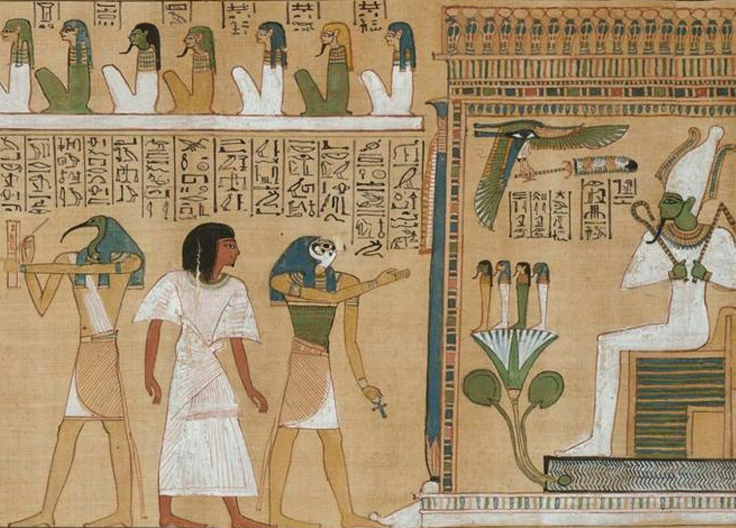
What makes the Book of the Dead especially fascinating for the traveller visiting Egypt is that its most iconic illustrations — the scene of the weighing of the heart, the solar barque crossing the underworld, the twelve hours of the night depicted as the corridors of a cosmic architecture — are reproduced with extraordinary quality in the tombs of the Valley of the Kings, in the papyri of the Egyptian Museum and in the sarcophagi of the Grand Egyptian Museum in Giza. They are not decorations: they are instructions.
"The Book of the Dead does not describe the afterlife: it prepares for it. Every spell, every illustration, every correctly pronounced name is one step further towards the light."
III. The judgement of Osiris: the most important scene in Egyptian art
The culminating moment of the journey to the afterlife — the one most frequently depicted in papyri, tombs and sarcophagi — is the Weighing of the Heart, also known as the Judgement of Osiris. It takes place in the Hall of Two Truths, and its protocol is described with minute precision in chapter 125 of the Book of the Dead.
The deceased appears before a tribunal presided over by Osiris, god of the dead, flanked by 42 divine assessors — one for each nome or province of Egypt — each responsible for judging a specific type of moral transgression. The deceased must recite before each of them the so-called Negative Confession: a series of declarations about what they have not done in life. 'I have not lied. I have not stolen. I have not killed. I have not acted with arrogance. I have not polluted the water. I have not made children weep.'
Then comes the weighing. The heart of the deceased — the ib, seat of all moral life — is placed on one pan of the scale. On the other, a feather: the feather of Maat, goddess of truth and cosmic order. If the heart weighs the same as the feather, the deceased is declared maa-kheru, 'true of voice', and may continue the journey. If the heart weighs more — burdened by wrongdoings, lies, acts of injustice — it is immediately devoured by Ammit, a chimeric creature with a crocodile's head, a leopard's body and a hippopotamus's hindquarters. And then occurs what the Egyptians feared above all else: the second death, total extinction, the permanent erasure of the being from the universe.
IV. The path: the twelve hours of the night
The Duat, the Egyptian underworld, was not a place of punishment but a territory of transformation that the soul had to traverse actively. It was organised as the twelve hours of the night, each with its gate, its guardians, its specific dangers and the secret names the deceased had to know in order to pass.
The stations of the nocturnal journey
I Entering the Duat. The deceased, guided by Anubis, the jackal-headed god, crosses the threshold of the underworld. The night of the soul begins.
II–IV The corridors of water and fire. Rivers of fire, lakes of darkness, many-headed serpents. The deceased sails in the solar barque alongside Ra, speaking the correct names at each gate.
V The Hall of Two Truths. The judgement of Osiris. The weighing of the heart. The moment that determines whether the deceased may continue or is devoured by Ammit.
VI–IX The hours of regeneration. Ra unites with Osiris in the deepest part of the underworld. The deceased, having passed the judgement, participates in that union and begins their own regeneration.
X–XI The battle against Apep. The great serpent of chaos attempts to devour the solar barque. The gods chain it. Cosmic order is reaffirmed once more.
XII The dawn. Ra emerges on the eastern horizon as Khepri. The deceased, now transfigured into an Akh, is reborn with the sun. Eternity begins.
V. Mummification: preserving the body to preserve the soul
Mummification was not, as is sometimes simplified, a hygienic form of cadaver preservation. It was a theological ritual lasting seventy days, presided over by specialist priests wearing the mask of the god Anubis. Its purpose was to replicate what Isis and Nephthys had done with the body of Osiris after Set murdered and dismembered him: to reunite the parts, preserve the form, ensure that the Ka had a physical home to return to.
The process began with the removal of the internal organs — liver, lungs, stomach and intestines, stored in the four canopic jars under the protection of the Sons of Horus — and the extraction of the brain through the nostrils, considered a lesser organ compared to the heart. The body was then covered in natron, a natural desert salt, for forty days to dehydrate it completely. It was then wrapped in linen bandages, with protective amulets placed in strategic positions between the layers, and the spells of the Opening of the Mouth were recited, restoring the deceased's ability to speak, eat, see and smell in the afterlife.
The quality of mummification depended on budget. Pharaohs and nobles received the complete treatment with aromatic resins, cedar oils, fine linen bandages and gold masks. Common citizens underwent a simpler process. The poor were simply buried in desert sand, whose heat and dryness preserved bodies naturally — some of them better than the most elaborate royal mummies.
"Mummification was not a medical or hygienic act. It was the first step of the most important journey a human being could undertake: the path towards eternal light."
VI. Reading the afterlife in the tombs: what the traveller can see
All of this cosmology is represented with extraordinary visual richness in the places that travellers can visit in Egypt. Not as decoration, but as functional text: the tomb paintings were, in the literal sense, the tools the deceased needed for their journey.
In the Valley of the Kings, the tomb of Ramesses VI contains one of the most complete representations of the Book of Caverns and the Book of the Earth. The ceiling of the funerary chamber shows the body of the goddess Nut — the sky — with stars tattooed on her skin, arched over the world: the sun enters through her mouth at sunset and is born from her womb at dawn. Egyptian cosmology in a single image, painted three thousand years ago on rock beneath the Luxor desert.
In the Egyptian Museum in Cairo, the Papyrus of Ani — one of the most complete and best-illustrated copies of the Book of the Dead — allows the weighing of the heart scene to be seen with a clarity and pictorial quality that makes it almost impossible not to be moved. Ani and his wife Tutu are depicted with a humanity and dignity that transcend the three thousand years separating them from the viewer. They are waiting for the verdict. As all of us, in some measure, await ours.
— ✦ —
"The Egyptians did not fear death. They feared not being prepared for it. Their temples, their tombs and their sacred texts were, all of them, a form of preparation."
To visit the Valley of the Kings and the Egyptian Museum with a focus on spirituality and the afterlife, contact our team and we will design your programme.