



TEMPLES & SACRED PLACES · EGYPT
The Temple of Abu Simbel
A journey to the heart of solar power
Abu Simbel · Ramesses II · Upper Egypt · Sacred Architecture · Private Experience · UNESCO Heritage
There are places in the world that are not contemplated: they are received. Abu Simbel is one of them. Carved into the living rock of the western bank of the Nile, just a few kilometres from the Sudanese border, this complex of two temples commissioned by Ramesses II more than three thousand years ago is not simply a monument to the power of a pharaoh. It is a cosmic statement of intent, a machine of light and stone calibrated so that the sun does, twice a year, exactly what the architect commanded.
I. Ramesses II and the politics of eternity
To understand Abu Simbel it is necessary to understand its creator. Ramesses II, the Great, ruled Egypt for 66 years — from 1279 to 1213 BC — and turned self-promotion into an art form. He was the pharaoh who commissioned the most statues of himself, who had the most commemorative texts inscribed, who built the most temples along the Nile. But Abu Simbel is not a work of vanity. It is a work of political theology: a temple conceived to project the pharaoh's divine presence to the ends of the known world, in the land of Nubia that Egypt had conquered and needed to keep under its influence.
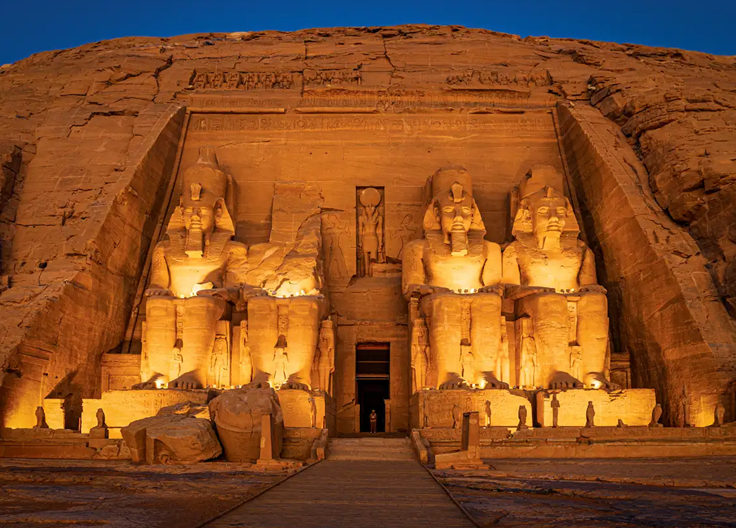
The four colossal seated statues of Ramesses flanking the entrance to the Great Temple — each more than twenty metres tall — are not there to impress the modern tourist. They are there to impress the Nubian arriving by the Nile, so that there could be no doubt about which god ruled these lands.
"Abu Simbel is not a temple dedicated to Ramesses. It is a temple in which Ramesses is, himself, the god. The distinction is subtle but changes everything."
II. The solar miracle: astronomy carved in stone
The most extraordinary wonder of Abu Simbel lies not in its size or the perfection of its reliefs, but in a phenomenon that occurs only twice a year: on 22 February and 22 October, at sunrise, the first rays of the sun penetrate the temple entrance, travel the 65-metre corridor and reach the sanctuary to illuminate directly the statues of Ra-Horakhty, the deified Ramesses and Amun. Only the figure of Ptah — god associated with darkness and the underworld — remains in shadow.
This phenomenon is not accidental. It is the result of an astronomically precise calculation carried out by the architects of the New Kingdom with no instruments other than direct observation of the sky. The 22nd of February coincides, according to Egyptologists, with the anniversary of Ramesses' coronation; the 22nd of October, with his birthday. The sun, literally, celebrates the pharaoh.
What makes this phenomenon even more extraordinary is that it survived the temple's relocation. When the construction of the Aswan Dam threatened to submerge Abu Simbel beneath the waters of Lake Nasser, UNESCO led between 1964 and 1968 one of the most ambitious archaeological rescue operations in history: both temples were dismantled into more than two thousand blocks of stone and rebuilt, centimetre by centimetre, 65 metres higher and 200 metres further inland. The solar alignment was preserved with a variation of barely one day.
Essential visit details
LOCATION: 280 km south of Aswan, western shore of Lake Nasser
SOLAR DATES: 22 February and 22 October — the alignment sunrise
RECOMMENDED ACCESS: Private flight from Aswan — 45 minutes. Access before opening
BEST TIME: Opening (5:00 h) or late afternoon, with horizontal light
III. The Great Temple: a journey through the theology of power
To cross the threshold of Abu Simbel is to enter an architecture of intimidation transformed into beauty. The great hypostyle hall — supported by eight Osirian pillars bearing the image of Ramesses as Osiris, each more than ten metres tall — is covered in reliefs narrating the pharaoh's battles, especially that of Kadesh against the Hittites, around 1274 BC. It is one of the most documented military episodes of Antiquity and also one of the earliest known examples of large-scale political propaganda: Ramesses presents as a victory what was, in reality, a negotiated draw.
Beyond the hypostyle hall, the temple narrows and deepens. Ceilings lower, light diminishes, the air thickens with a mineral humidity that smells of centuries. The walls are covered in hieroglyphic inscriptions with the pharaoh's cartouches repeated to infinity — a deliberate technique so that, even if time erased part of the inscriptions, the king's name would remain. Ramesses designed his immortality with the same meticulousness with which he designed his military campaigns.
IV. The Temple of Nefertari: when love is carved in rock
A few metres from the Great Temple stands the Temple of Hathor, commissioned by Ramesses in honour of his favourite wife, Nefertari. It is a gesture without precedent in the history of Ancient Egypt: no pharaoh had ever dedicated a temple of these dimensions to his consort. The facade is flanked by six colossi of more than ten metres — four representing Ramesses and two Nefertari — and the inscription running above the entrance is, in its terseness, one of the most beautiful phrases Ancient Egypt left us: 'For she for whom the sun shines.'
The interior of the temple is more intimate than the Great Temple, and its colours — ochres, lapis lazuli blues, malachite greens — have been preserved with extraordinary vividness. The reliefs show Nefertari making offerings to the goddesses Hathor and Isis, but also, in an iconographic choice that is exceedingly rare, performing rites normally reserved for the pharaoh. Ramesses granted her, in stone and for eternity, a divine dignity.
"That a pharaoh dedicated a temple to his wife was, in the context of Ancient Egypt, as extraordinary as if a head of state today renounced their own monument to erect one for another. Love, here, has the scale of a mountain."
V. How to reach Abu Simbel with the distinction it deserves
Most visitors arrive at Abu Simbel by coach from Aswan, in a police-supervised convoy that departs at 4:00 in the morning and returns in the early afternoon. The visit lasts, in that format, between two and three hours. It is enough to see. It is insufficient to feel.
Our luxury programmes offer a completely different approach. Access by private aircraft or scheduled flight in first class from Aswan — a 45-minute flight over the desert and Lake Nasser — allows arrival at the opening of the site, before the first convoys appear. The temple in that first hour has a dimension that disappears with the sun at its zenith: the light enters obliquely, the colossi cast long shadows, and the silence is of a different category.
For the solar alignment dates — 22 February and 22 October — we recommend booking at least six months in advance. Access that morning is limited, the emotion of watching the sun's rays travel the interior corridor and touch the statues of the sanctuary does not repeat itself, and breakfast in the desert overlooking Lake Nasser, after the experience, closes the circle with the calm the moment deserves.
VI. Abu Simbel within a larger itinerary
Abu Simbel works, in terms of an Egyptian itinerary, as the final point of a progression. It is best visited after Karnak and Luxor, after the Valley of the Kings, after having sailed the Nile and understood the scale of the country. Then, upon arriving at the extreme south, at that landscape of red desert and still water where the temples emerge from the rock as if they had always been there, the emotion has historical depth. It is not just surprise at the immense. It is recognition.
Combined with a night at the Anantara Sir Bani Yas in Aswan — or aboard a private dahabiya on the still waters of Lake Nasser — Abu Simbel ceases to be an excursion and becomes what it always should have been: an encounter.
— ✦ —
"Abu Simbel does not await your admiration. It has spent three thousand years awaiting your silence."
To include Abu Simbel in your exclusive Egyptian programme, with private access and permit management, contact our team.