



WELLNESS & SPIRITUALITY · ANCIENT EGYPT
Rituals Inspired by Ancient Egypt
Aromatherapy, sound and consciousness
Egyptian Rituals · Aromatherapy · Sound Healing · Kyphi · Sistrum · Wellness · Consciousness
Long before aromatherapy had a name, the priests of the temple of Edfu prepared each dawn a blend of resins, spices and honey called Kyphi to burn before the gods. Long before sound healing existed as a discipline, the priestesses of Hathor shook the sistrum — a metal percussion instrument whose sound was believed to drive away chaos and summon divine presence — in sacred processions. Ancient Egypt was, among many other things, a profoundly sensory civilisation: it understood that the body is the gateway to consciousness, and that aromas, sounds and rhythms are the keys to that gateway.
I. The body as temple: the Egyptian vision of wellbeing
Egyptian medicine and spirituality were not separate disciplines: they were facets of the same knowledge. The priest-physicians — swnw in the Egyptian language — practised surgery, pharmacology, ritual magic and what we would today call psychology simultaneously. The Ebers Papyrus, dated around 1550 BC and one of the most complete medical treatises of Antiquity, mixes prescriptions of medicinal plants with protective spells and purification rituals as if they were part of the same protocol. Because they were.
For the Egyptians, illness was not only a physical imbalance: it was also a signal of misalignment with Maat, the principle of cosmic order. To heal meant to restore that order on all levels simultaneously: in the body, in the mind and in the individual's relationship with the gods. The temple was the privileged space for that restoration, and the rituals of aroma, sound and purification were its principal tools.
This holistic vision is precisely what the most sophisticated wellness programmes in the world are rediscovering today: that treating the body in isolation from mind and spirit is a useful but incomplete abstraction. The Egyptians knew this three thousand five hundred years ago. They had it inscribed on the walls of their temples.
"The Egyptian priest made no distinction between physician and spiritual teacher. Healing the body and expanding consciousness were, for him, the same act."
II. Kyphi: the sacred perfume that prepared the soul
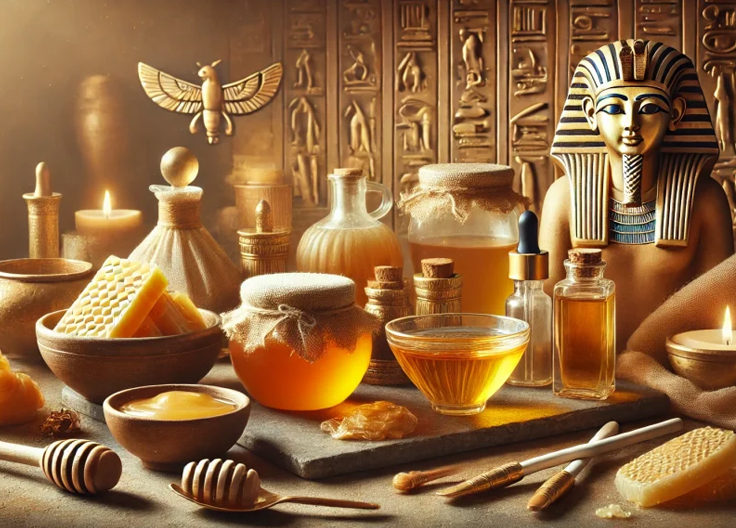
Kyphi — kp.t in ancient Egyptian — is the most complex and mysterious incense of Antiquity. Its most detailed formula was inscribed on the walls of the temple of Edfu and the temple of Philae, and archaeologists have identified up to sixteen distinct ingredients: myrrh, frankincense, juniper resin, iris root, calamus, cedar wood, cassia, mint, sweet rush, raisins and honey, among others. Preparation took several days, followed a precise ritual protocol and was accompanied by the recitation of sacred texts. The final result was burned in temples at sunset to protect the god Ra on his nocturnal journey and to facilitate the prophetic dreams of the priests.
The Roman writer Plutarch, who visited Egypt in the 1st century AD, left a description of the effect of Kyphi that reads as surprisingly modern: he claimed its aroma relaxed the body, dissolved the tensions of the day, induced clear dreams and ordered the mind for contemplation. What he was describing, without knowing it, was the combined action of the volatile compounds of the ingredients on the central nervous system — something contemporary aromatherapy has confirmed with instruments Plutarch did not have.
Today, some high-end spas in Egypt and around the world offer treatments based on Kyphi formulas. The experience of inhaling that combination of resins and spices in the context of a temple or a meditation ritual carries an olfactory density that activates a state of quiet alertness the Egyptians would have recognised without need of explanation.
The sacred aromas of Ancient Egypt
Myrrh · (Commiphora resin) — Associated with Isis and resurrection. A central ingredient in the mummification process and in Kyphi. Symbol of the eternal and of transformation.
Frankincense · (Boswellia sacra — Punt) — Brought on expeditions from the land of Punt. The white smoke was the visible form of prayer ascending towards the gods.
Cedar · (Lebanese timber) — Used in mummification oils and in scalp treatments. Symbol of immortality and protection.
Blue lotus · (Nymphaea caerulea) — The most sacred aroma of the Nile. Associated with the sun, rebirth and the opening of consciousness. With mild psychoactive properties.
Calamus · (Acorus calamus) — A plant of the Nile marshes, used in ritual unguents and in preparations for mental clarity and meditation.
Henna · (Lawsonia inermis) — Its flowers perfumed body oils. Symbol of fertility, protection and joy. Used in celebrations and rites of passage.
III. The sistrum and sacred sound: how the Egyptians used vibration
The sistrum is one of the oldest musical instruments in the world: it appears in Egyptian reliefs dating from the fourth millennium BC. It consisted of a bronze frame with transverse rods from which small metal discs hung, producing when shaken a dry, bright sound. It was the instrument of Hathor, goddess of love, music and joy, and was used in her sacred processions for a specific purpose: the sound of the sistrum drove away Set — the god of chaos — and summoned the benign presence of the gods.
Beyond its ritual function, contemporary researchers have observed that the frequencies produced by the sistrum — between 200 and 800 hertz, with a harmonic richness characteristic of bronze instruments — fall within the range that modern neuroacoustics associates with states of relaxed alertness and deep emotional processing. Ancient Egypt lacked the tools to measure this. But it had three thousand years of empirical observation of which types of sound produced which types of states in ritual practitioners.
The crystal and quartz singing bowls used today in modern sound healing sessions share with the sistrum a fundamental logic: the conviction that sound acts directly on the nervous system and on consciousness. The Egyptians called this heka: magic as a natural force inherent in sound and in speech.
"The sistrum was not a musical instrument in the modern sense. It was a spiritual technology: a tool designed to modify the inner state of the one who shook it and of the one who heard it."
IV. An Egypt-inspired wellness ritual: step by step
The wellness programmes we offer on our Egyptian journeys integrate elements of the Egyptian sensory tradition into a contemporary sequence that honours the original spirit. The following ritual can be practised in the context of a temple, a hotel treatment room by the Nile, or any interior space with sufficient silence and attention.
The five-senses ritual
I Purification with aromatic water. The ritual begins with the washing of hands and feet in water infused with lotus and myrrh oils. In Egyptian temples, purification with water was the first act of any sacred rite. The cleansed body was the appropriate vessel for what followed.
II Aromatic activation with Kyphi. A blend of frankincense and myrrh resin is burned while the practitioner breathes consciously, following the four-count rhythm described in the texts of Sekhmet: four counts to inhale, four to hold, four to exhale. The aroma is the gateway into the ritual state.
III Sound bath with quartz bowls. The therapist works with bowls tuned to 432 and 528 hertz frequencies. The session lasts between twenty and forty minutes. The practitioner remains in the supine position, eyes closed, allowing the sound to travel through the body.
IV Meditation with Duat visualisation. Guided by voice, the practitioner mentally traverses the twelve hours of the Egyptian underworld as a metaphor for the inner journey: each gate as a layer of resistance that dissolves, the final dawn as the emergence of a wider consciousness.
V Integration with spikenard oil and silence. The ritual concludes with the application of spikenard oil — used in Egyptian funerary unguents — to the temples, throat and chest. Ten minutes of complete silence for what has been experienced to settle.
V. Where to experience these rituals in Egypt
The experience of a wellness ritual inspired by Egyptian tradition reaches its fullest power when the physical context adds its own layer of meaning. There are three settings we consider incomparable: the bank of the Nile at dawn aboard a dahabiya between Luxor and Aswan; the precinct of the temple of Philae in Aswan, accessible by private visit at sunset, where the last known hieroglyphs of the ancient world were inscribed in 394 AD; and the treatment rooms of the Anantara Old Cataract in Aswan, with high-end protocols incorporating Egyptian tradition ingredients — lotus oils, myrrh, Nile clay — in a five-star setting.
Each of these spaces adds to the ritual a dimension no urban spa can replicate: the presence of a place that has been the setting for transformative practices for thousands of years. The stone holds something. The water holds something. The silence of the desert holds something. And when these rituals are practised in that context, the body perceives it before the mind does.
VI. Taking the ritual home: aromas and practices after the journey
One of the things we most frequently hear from travellers who have lived these experiences is that the effect does not end when the journey does. Aromas, in particular, have an extraordinary anchoring capacity: the smell of myrrh or frankincense can instantly return the consciousness to the state experienced in the temple, months or years later.
This is why we always recommend bringing home a small collection of aromas: myrrh resin from the Aswan spice market, lotus oil in a small bottle, a piece of cedar or sandalwood to burn. And the five-minute practice — conscious inhalation, a few minutes of silence with eyes closed — that can become an anchor to a state that Egypt taught one to recognise.
Ancient Egypt did not invent wellbeing. But it may have been the first civilisation to understand that true wellbeing is not the absence of tension: it is the presence of consciousness. A teaching that, three thousand five hundred years later, remains completely contemporary.
— ✦ —
"The Egyptians built their temples so that human beings could, within them, remember who they were. The rituals were the key. The silence was the door."
To include Egyptian wellness rituals and aromatherapy in your travel programme, contact our team and we will design your experience.