



TEMPLES & SACRED PLACES · EGYPT
Luxor Temple at Sunset
When stone turns into light
Luxor Temple · Sunset · Amenhotep III · Ramesses II · Sensory Experience · Sacred Architecture
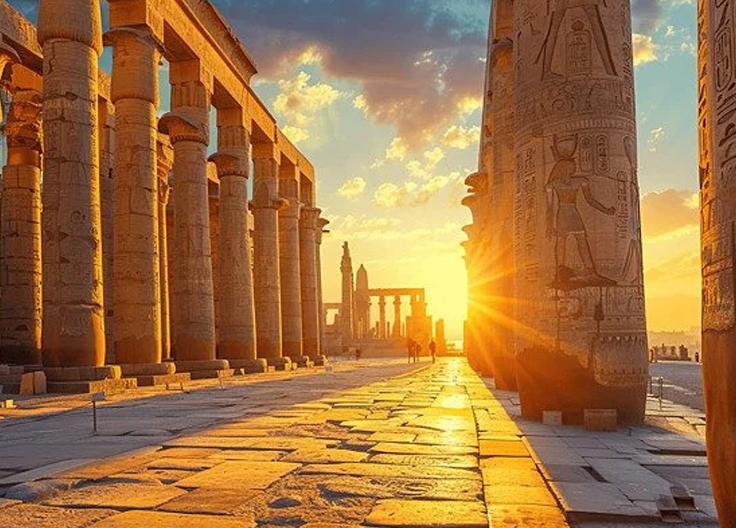
There is a moment in Luxor that no photographer has ever fully captured, though thousands have tried. It happens between six and seven in the evening, when the sun of Upper Egypt descends towards the western horizon — the same horizon that the ancient Egyptians called Amenti, the land of the dead and resurrection — and its last rays strike the temple columns from the side. The honey-coloured sandstone ignites. The shadows lengthen until they almost double the height of the pylons. And the Luxor Temple, which during the day is an impressive monument surrounded by tourists, becomes, in that quarter-hour of grace, something that belongs to an entirely different category of experience.
I. A temple built in two moments, by two geniuses
The Luxor Temple is, architecturally, a conversation between two pharaohs separated by more than a century. The original core was built by Amenhotep III, the great king of the New Kingdom who ruled Egypt between 1388 and 1351 BC, during one of the periods of greatest prosperity and artistic splendour in all of pharaonic history. His temple was a structure of austere, proportioned elegance: the great colonnade with its 32 papyriform pillars, the inner sanctuary, the processional avenue of sphinxes connecting the precinct to the temple of Karnak three kilometres to the north.
A century later, Ramesses II — the same pharaoh who carved the colossi of Abu Simbel — added the first pylon, the great court and the six colossal statues that still flank the entrance today. He also placed two red granite obelisks from Aswan before the pylons; one remains in its original position. The other, in 1836, was gifted by the Egyptian government to France, where it now stands at the centre of the Place de la Concorde in Paris. Its absence, paradoxically, gives the remaining obelisk a solitude that proves more eloquent than any pair.
The difference between the two building campaigns is visible and beautiful: Amenhotep's architecture has a restraint and a near-musical perfection; Ramesses' has a declarative exuberance, a will to impress that is not incompatible with mastery. Together they create a temple of such layered richness that it could occupy days of study.
"The Luxor Temple was not built for any particular god. It was built for the process of rejuvenating royal power: the place where the pharaoh was transformed, once a year, into a god."
II. The temple's purpose: the mystery of royal regeneration
Most great Egyptian temples are dedicated to a specific deity. The Luxor Temple is an exception that Egyptologists have spent decades trying to explain precisely. Its primary function appears to have been to host the Opet festival, the most important celebration in the New Kingdom's liturgical calendar, held once a year during the second month of the Nile flood.
During the Opet, the sacred statue of the god Amun travelled from his sanctuary at Karnak to the Luxor Temple in a processional barque, surrounded by priests, musicians, dancers and thousands of pilgrims. The purpose of the journey was, according to the texts, the rejuvenation of the royal ka: the pharaoh entered the sanctuary as a man and emerged, renewed in his divine power, as a god. It was, in every sense, a liturgy of transformation.
This function explains a feature of the temple that surprises those who discover it: inside the deepest sanctuary, built by Amenhotep III and later reformed by Alexander the Great — who had himself depicted in the reliefs as a legitimate Egyptian pharaoh, with all the attributes of the office — there are paintings that are not Egyptian. They are Roman paintings from the 3rd century AD, made when the sanctuary was converted into a chapel for the imperial cult. The Luxor Temple is, layer upon layer, an archive of three thousand years of uninterrupted religious history.
III. The Avenue of Sphinxes: the procession that crosses the city
One of the most ambitious archaeological projects in Egypt in decades was completed in 2021: the restoration of the Avenue of Sphinxes connecting the Luxor Temple to Karnak. Three kilometres of ram-headed sphinxes — the sacred animal of Amun — flanking a ceremonial road that time and the modern city had buried beneath entire districts of Luxor.
The excavation and restoration required the demolition of hundreds of modern buildings, the relocation of entire communities, and the work of archaeologists over nearly twenty years. The result is one of the most extraordinary perspectives in contemporary archaeology: walking the three kilometres from the Luxor Temple to the gates of Karnak along the same route taken by sacred processions three thousand years ago, flanked by more than a thousand stone sphinxes, at dawn or at dusk, when there is no one else.
This experience — the complete avenue on foot, with a guide explaining each station of the procession, followed by a private visit to Karnak before official opening — is one of the itineraries that most deeply moves the travellers who take it. And it is, still, unknown to the majority.
The temple's light: hour by hour
DAWN · 5:30–6:30H: Pink and blue light. Columns casting enormously long shadows westward. The temple in near-absolute solitude.
MID-MORNING · 9–11H: White, hard light. Ideal for relief details. Moderate heat. Tour groups beginning to arrive.
MIDDAY · 12–15H: Vertical light, short shadows. The stone loses volume. Intense heat. Avoid in summer.
SUNSET · 17–18:30H: The golden hour. The sandstone ignites. Long, dramatic shadows. The temple at its visual peak.
NIGHT · FROM 19H: Warm artificial lighting. The Nile in the background. Quiet atmosphere. The corniche at its finest.
IV. Alexander, Rome and Islam: the temple's other lives
One of the things that makes the Luxor Temple particularly extraordinary is that it never ceased to be an active place of worship during the three thousand years following its construction. When Alexander the Great arrived in Egypt in 332 BC, he did not plunder the temples: he reformed them, had himself depicted in their reliefs as a legitimate pharaoh, and commissioned the rebuilding of the deepest sanctuary of the Luxor Temple, which today holds paintings that blend Egyptian and Hellenistic iconography with an ease that astonishes.
When Egypt became part of the Roman Empire, the sanctuary was reformed again: the 3rd-century paintings still preserved in the sanctum show a procession of Roman soldiers with standards, depicted in the same visual language that Egyptian priests had used for centuries to represent sacred processions. The form changes; the function remains.
And then, inside the precinct, there is a mosque. The Abu Haggag Mosque, built over the temple walls in the 13th century, remains active today. Its worshippers pray on the same stones that the priests of Amun consecrated three thousand years ago. The entrance to the mosque is now several metres above the level of the temple court: the physical testimony of how many centuries of sediment, of accumulated history, separate the modern world from the ancient one.
"No other temple in the world has been, without interruption, a place of Egyptian, Hellenistic, Roman, Christian and Islamic worship. The Luxor Temple is not a monument. It is a living organism that has been transforming for three thousand years."
V. The corniche walk: Luxor beyond the temple
Luxor is one of the most singular cities in the world: a modern city of half a million inhabitants built literally on top of one of the densest archaeological concentrations on the planet. The contrast between everyday Luxor — its plastic cafés, its motorcycle taxis, its synthetic-fabric markets — and the grandeur of what lies beneath and around it can seem disorienting at first, and revelatory afterwards.
The corniche, the promenade bordering the Nile on the east bank, is the place where the two worlds meet most gracefully. At sunset, when the sun sets behind the mountains of the west bank — the same mountains under which the tombs of the Valley of the Kings are carved — the promenade fills with families, sugar cane vendors, children on bicycles and tourists who have just left the temple. White-sailed feluccas cross the Nile in silence. The scent of spices from the nearby market arrives on the breeze.
For the discerning traveller, the corniche at sunset followed by dinner on the terrace of the Winter Palace hotel — built in 1886 overlooking the Nile, where Agatha Christie and Howard Carter stayed during excavation seasons — is one of those sequences of hours that justify a journey. Not for what there is to see, but for what is felt.
VI. How to experience the Luxor Temple as it deserves
The Luxor Temple is open every day of the year, including evenings, when the artificial lighting transforms it into a different but equally beautiful spectacle. The standard visit lasts between forty-five minutes and an hour. The visit that leaves a mark lasts two to three hours, includes the walk along the Avenue of Sphinxes, explores the inner sanctum reformed by Alexander, ascends the pylons of Ramesses to see the temple from above, and ends on the corniche with the exact light of the sunset.
For those who wish to go further, the private dawn visit — before official opening, with access managed through the Luxor Antiquities Office — makes it possible to stand alone in Amenhotep III's court when the morning light enters horizontally between the columns and the silence has not yet been broken by any excursion group. It is one of those moments that travellers describe, years later, as the sharpest memory of their entire Egyptian journey.
Combined with a night at the Al Moudira hotel on the west bank, or aboard a dahabiya anchored off the corniche, the Luxor Temple at sunset ceases to be a visit and becomes what the architects who built it intended: a threshold.
— ✦ —
"In Luxor, the stone does not reflect sunlight. It absorbs it, holds it for hours, and releases it at sunset, transformed into something for which we have no name."
To include Luxor Temple in your exclusive Egyptian programme, with private dawn access and specialist guide, contact our team.