



EXCLUSIVE EXPERIENCES · EGYPT
Night in the White Desert
Luxury, silence and infinite sky
White Desert · Bahariya Oasis · Desert Night · Starry Sky · Glamping · Silence · Sahara
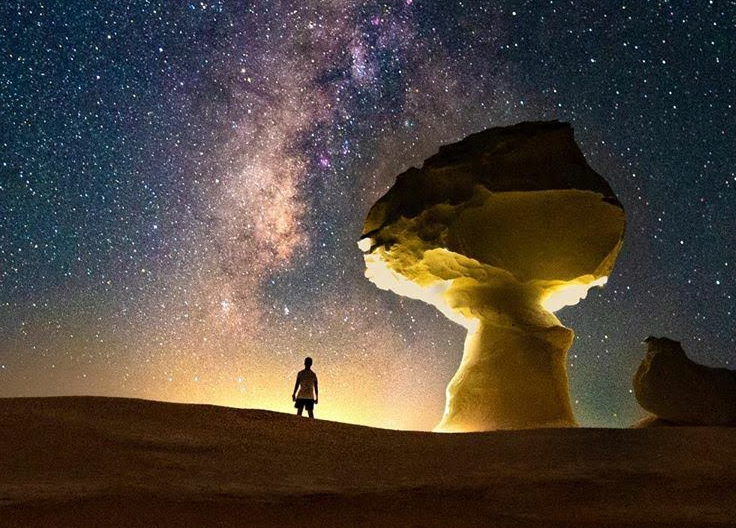
About 370 kilometres south-west of Cairo, beyond the Bahariya Oasis, the Sahara produces one of its most improbable and most beautiful landscapes: the White Desert. Formations of ivory-coloured gypsum and limestone — sculpted by thousands of years of wind erosion into shapes recalling giant mushrooms, fossilised icebergs, human figures in trance — rise above a sand of almost blinding white. At night, under the full moon, the landscape becomes something the mind categorises as unreal before accepting it: a world of white formations emerging from the darkness, beneath the densest starry sky most European travellers will ever see in their lives.
I. The White Desert: the geology of the sublime
The White Desert — known in Arabic as Al-Sahara Al-Baida — was formed during the Late Cretaceous period, approximately 70 million years ago, when this region was covered by a shallow sea. The calcareous sediments deposited on the seabed emerged over time and were sculpted by the winds over millennia into the forms that define the landscape today: pillars, arches, mushrooms, figures up to ten metres tall that change colour as the light progresses through the day.
At dawn, the formations are a pale pink. By mid-morning, a cream white that reflects the light with an intensity demanding sunglasses. At sunset, the low sun tints them orange, ochre and red. And at night, under the moon, they acquire their own luminosity: white limestone reflects moonlight with extraordinary efficiency, so that even on moonless nights it is possible to walk among the formations without a torch.
The White Desert covers about 3,000 square kilometres and has been a National Park since 2002. It is one of the most fragile and most extraordinary landscapes in Africa.
"The White Desert is the only place in the world where geology produces something the human brain instinctively classifies as art. Not as nature: as art."
II. The luxury camp: when comfort and silence are reconciled
A night in the White Desert need not choose between authenticity and comfort. The best private camps we organise combine total immersion in the landscape with a layer of sophistication that makes it possible to enjoy the environment without the discomforts that backpacking tourism inevitably entails.
The camp is always set up away from well-trodden routes, in a location selected that same day based on the position of the finest formations, wind direction and the angle of the evening light. The tents are of high-quality canvas with a rigid structure — not conventional camping tents — with real beds, high-density cotton bed linen, Bedouin carpets on the floor and a portable bathroom with hot water.
The cooking is done over a wood fire: red lentil soups, lemon-spiced chicken, rice with pine nuts, pitta bread baked in the embers, herbal tea with cardamom. The cook — from the Bahariya Oasis, with decades of experience in desert cooking — works with ingredients brought from that morning's market.
The private camp in figures
DISTANCE FROM CAIRO: 370 km — 4.5 hours in a private 4×4 along the paved road to Bahariya and desert track.
CAPACITY: 2 to 8 people. Individual or double tents depending on configuration.
BEST SEASON: October to March. Night temperature between 5 and 15°C. Warm clothing essential.
SKY: Bortle class 2. Milky Way visible to the naked eye. No light pollution in sight.
VEHICLE: Private 4×4 with local Bedouin guide. Off-track access only with guide.
INCLUDED: Transfer from Cairo or Bahariya, desert dinner and breakfast, guide, luxury camp equipment.
III. The night: a 14-hour programme that needs no agenda
A night in the White Desert has its own rhythm, not imposed but discovered. There is a sequence of moments that travellers who have lived it describe so consistently that it is worth sharing:
The course of a perfect night
16:00 Arrival in the desert. The 4×4 leaves the paved track. The landscape changes within a few kilometres: from golden sand to white formations. The first views of the White Desert almost always produce spontaneous silence in the vehicle.
17:00 Setting up camp. The tents are already up. Welcome tea waits on a Bedouin carpet among the formations. First walk around the immediate surroundings while the sun still gives lateral light.
18:30 The golden hour and sunset. The low light tints the formations orange and red. The shadows lengthen and multiply the three-dimensionality of the landscape. The silence is so absolute that one can hear one's own heartbeat.
19:30 Dinner by the fire. The temperature has dropped ten degrees. The wood fire is the centre of the evening. Stars begin to appear one by one. Conversation takes on the particular quality of nocturnal conversations in the desert: more honest, slower, more necessary.
21:00 The full sky. The Milky Way is a dense band on the southern horizon. The white formations shine with starlight. The Bedouin guide points out the constellations his ancestors used to navigate the desert.
04:30 Dawn in the desert. The quietest and coldest moment of the night, as the sky moves from black to deep blue to pink. The formations receive the first rays of the sun with the unhurried patience of something that has been doing this for seventy million years.
IV. The White Desert sky: astronomy with feet in the sand
The White Desert occupies a geographically privileged position for astronomical observation. Its latitude — approximately 28 degrees north — allows the simultaneous visibility of northern and southern hemisphere constellations that in Europe never share the same visible sky. Its absolute absence of light pollution guarantees Bortle class 2 skies, one of the best darkness ratings available in North Africa.
The Milky Way is visible as a clearly structured band. The Andromeda and Triangulum galaxies are observable to the naked eye on moonless nights. Visible planets appear with a brightness incomparable to any urban setting. And the zodiacal light phenomenon — that diffuse luminosity extending from the horizon to the zenith along the ecliptic — is clearly perceptible on the darkest nights.
For travellers with an interest in astronomy, the camp can include a portable telescope and a guide capable of connecting what is visible in the sky with Egyptian cosmology: the same stars that the pyramid builders used to calculate their alignments, now visible above the white Saharan formations with a clarity that returns something of what the ancient world saw every night.
"Seeing the Milky Way over the White Desert is not an astronomical experience. It is an experience of scale: the moment when a human being understands, sensorially rather than intellectually, their precise place in the cosmos."
V. The Bahariya Oasis: the gateway to the desert
Access to the White Desert normally passes through the Bahariya Oasis, about 350 kilometres from Cairo. Bahariya is a real oasis — with date palms, hot springs, olive and pomegranate groves — and also the site of one of the most extraordinary archaeological discoveries of recent decades: the Valley of the Golden Mummies, a Ptolemaic-period necropolis discovered accidentally in 1996 when a donkey stepped through the roof of a tomb, revealing beneath hundreds of mummies with golden cardboard masks still being excavated and studied.
A half-day visit to the Bahariya archaeological museum and the oasis's natural hot springs — whose temperature hovers around 40 degrees year-round, fed by Saharan aquifers — is a perfect complement to the desert itinerary. The contrast between the green of the oasis, the white of the desert and the black of the night sky creates an experience that the traveller remembers as a single day that contained three entirely different worlds.
VI. Why the White Desert belongs to the category of the transformative
There are journeys that produce memories and journeys that produce change. The first category is more numerous. The second, rarer and more valuable. A well-lived night in the White Desert belongs to the second.
Not because of the landscape itself, though the landscape is extraordinary. But because of what total silence, a boundless sky and the complete absence of urban reference do to the nervous system of someone who inhabits them for twelve hours. There is a kind of defragmentation that happens in the desert that happens nowhere else — not in any spa, meditation retreat or luxury beach resort: the sense that the world has simplified down to its essential elements — sand, stone, sky, fire, silence — and that in that extreme simplicity the inner noise the traveller had been carrying without knowing it begins, finally, to yield.
Travellers who have spent a night in the White Desert describe it, consistently, as an experience they needed without having known it. It is the kind of description that the world's finest destinations produce in the world's finest travellers.
— ✦ —
"The White Desert has nothing to teach you. It only has silence to offer, and silence, when deep enough, teaches everything."
To include a night in the White Desert in your Egyptian programme, contact our team and we will design the perfect experience.