



TEMPLES & MYSTERIES · ANCIENT EGYPT
The Mystery of the Osireion at Abydos
Impossible architecture and initiatic symbolism
Osireion · Abydos · Osiris · Megalithic Architecture · Mystery · Initiation · Symbolism
There are structures in Egypt that conventional archaeology has catalogued, dated and explained with greater or lesser certainty. And there is one that it has not. The Osireion at Abydos — that chamber of massive granite excavated at the water table level behind the temple of Seti I — is, in the view of a significant portion of the researchers who have studied it, technically incompatible with the constructive capabilities of the Egyptian New Kingdom. Not because it is larger than other structures of the period, but because it is radically different: in its materials, its style, its monolithic scale and the absolute silence of its walls, which lack any inscription or decoration that might allow it to be dated with certainty. The Osireion raises questions that orthodox archaeology has not yet fully answered. This article makes them visible.
I. Abydos: the city where Osiris found his rest
To understand the Osireion it is necessary first to understand Abydos. This city was for more than two thousand years the most sacred place in Ancient Egypt. Its importance derived from a fundamental belief: that the head of Osiris, the god of death and resurrection, was buried there. According to the myth, after Set dismembered his brother's body and scattered its parts across Egypt, Isis gathered the fragments, but the head had come to Abydos. The place was forever consecrated as the threshold between the world of the living and the world of the dead.
The consequence of that belief was extraordinary. During the Middle and New Kingdoms, being buried at Abydos or having a votive stele there was the highest funerary aspiration of any Egyptian who could afford it. Pharaohs built cenotaphs there even though their actual tombs were in the Valley of the Kings. Nobles sent statues and stelae to ensure their spirit would participate in the sacred Osirian processions held each year. It was, literally, the point of contact between existence and eternity.
In that context, Seti I — one of the most powerful pharaohs of the New Kingdom, father of Ramesses II — commissioned at Abydos around 1280 BC one of the most beautiful temples in all of Egypt. And behind that temple he commissioned the building of — or, according to some researchers, the excavation and restoration of — something completely different: the Osireion.
"The Osireion does not seem built to be seen. It seems built to be felt, inhabited, traversed. It is an architecture of the threshold, not of spectacle."
II. The structure: what the eyes see and the mind cannot comprehend
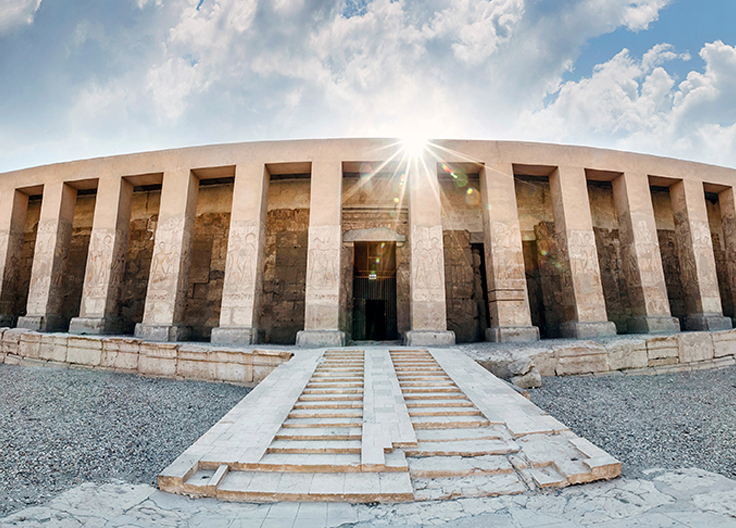
The Osireion is an underground structure excavated considerably deeper than the Seti temple surrounding it. To reach it one must descend several metres down an inclined corridor, going literally below the desert floor until reaching the water table of the subterranean Nile. At certain times of year, when the water level rises, the central chamber becomes partially flooded: monolithic granite columns rising from dark water in the silence of the rock.
The central hall has a rectangular granite island raised above the water, surrounded by a moat that encircles it completely. Eleven rectangular niches open in the granite walls. The original roof, long since vanished, consisted of monolithic granite blocks of extraordinary dimensions: some weigh, according to archaeological calculations, between 100 and 150 tonnes. The walls are of Aswan granite with no mortar whatsoever, assembled with millimetre precision.
And the walls are completely bare. There are no reliefs, no inscriptions, no cartouches, no paintings. There is granite. Silence. And water.
The features that perplex archaeologists
I The style is megalithic, not pharaonic. The monolithic granite blocks without mortar, assembled with extreme precision, are characteristic of a constructive tradition that archaeologists associate with periods far older than the New Kingdom: the same techniques appear in the valley temple of Khafra at Giza, dated to the Old Kingdom or possibly earlier.
II The total absence of inscriptions. In Ancient Egypt, leaving a sacred structure without inscriptions was inconceivable. The Osireion, in the most sacred site in Egypt, is completely silent. This either indicates an antiquity that predates pharaonic writing, or a deliberate intention to keep it outside ordinary language.
III The burial depth is anomalous. The Osireion is excavated several metres deeper than the New Kingdom structures surrounding it. This depth implies either that it was built when the ground level was lower — meaning much earlier — or that it was intentionally buried, which in Egyptian tradition carries specific symbolic meaning linked to the underworld.
IV The blocks are disproportionately large. For the New Kingdom, builders used manageable blocks of limestone and sandstone. The Osireion uses Aswan granite in blocks requiring a logistical and lifting technology that archaeologists have not fully explained for that period.
III. The dating: the debate archaeology has not closed
The official archaeological position attributes the Osireion to Seti I, around 1280 BC, based on the fact that Seti's name appears in some texts of the access corridor and in the ceiling decorations added later. However, several researchers have pointed out that the constructive style of the central chamber is incompatible with that of the decorated corridor preceding it, and that the most parsimonious evidence is that Seti I found an older structure and incorporated it into his temple complex.
If this hypothesis is correct — and there is no definitive academic consensus — the Osireion might be contemporary with the megalithic structures of the Giza complex: the Old Kingdom, the predynastic period, or possibly earlier. A dating that would place it among the oldest monuments in Egypt and, possibly, among the oldest human constructions on the planet.
What is not in dispute is that the symbolism of the Osireion is perfectly coherent with Ancient Egyptian cosmology: the central island surrounded by water represents the primordial mound of creation, the Nun, which emerged from the aquatic chaos at the origin of the world. To be in the Osireion is, symbolically, to be at the beginning of all things.
IV. The initiatic symbolism: death and rebirth in granite
Beyond the debate over its dating, the Osireion has a symbolic function that Egyptologists understand clearly: it was the cenotaph of Osiris, the place where the most important god of the Egyptian funerary pantheon was ritually buried and ritually resurrected each year during the festivals of Abydos. The pharaoh, priests and initiates who participated in those ceremonies recreated the myth of Osiris's death and resurrection in the physical space of the chamber: they descended to the water table, to the realm of water and darkness, and returned transformed.
This pattern — descent, threshold, resurgence — is the structure of all initiatic rites that humanity has generated across all cultures and all historical periods. The flooded underground space as a metaphor for the death necessary for rebirth is one of the most universal archetypes of sacred symbolism. The Osireion constructed it literally in granite.
For the traveller who descends today down the inclined corridor and reaches the central chamber — especially if done privately, with a torch as the only light source — the dimension of that symbolism requires no intellectual explanation. The scale of the granite blocks, the darkness of the water, the silence that the rock amplifies rather than absorbs: the body understands it before the mind does.
"Descending into the Osireion is not visiting a ruin. It is descending to the beginning. To the place where water, darkness and granite recreate the original condition of all that exists."
V. The Flower of Life: the carving that should not be there
On one of the granite columns of the Osireion there is a carving that has generated a disproportionate debate among archaeologists, mathematicians and students of sacred symbolism: the so-called Flower of Life, a geometric pattern formed by multiple overlapping circles that generates, when developed, all the fundamental geometric forms found in nature. The same pattern appears in cultural traditions on every continent: in Roman mosaics, in Hindu temples, in medieval European manuscripts, in Gothic cathedrals.
The debate about the carving centres on its technique and its age. The pattern does not appear to have been incised with standard pharaonic tools: it seems to have been carved or burned onto the granite surface using a technique that some researchers consider incompatible with the instrumentation available in any period of Ancient Egypt. Precise dating is impossible with current techniques.
The Osireion thus accumulates a series of anomalies that no single theory explains satisfactorily: uncertain dating, monolithic scale, the absence of inscriptions, anomalous burial depth, and a sacred-geometry carving of unknown technique. It is not a mystery that archaeology has solved. It is a mystery that archaeology has catalogued and will continue to study.
Essential details for visiting the Osireion
LOCATION: Abydos, 160 km north of Luxor. Behind the temple of Seti I.
ACCESS: Included in the Seti I temple ticket. Requires descending an inclined corridor.
CONDITION: Partially flooded in flood season. Always with high humidity.
SIGNAGE: Minimal. No explanatory signs. A specialist guide is essential.
LIGHTING: Very scarce. Torch or head-lamp recommended. The interior is dark by design.
GROUPS: Rarely visited. With a private programme, it is possible to have it entirely alone.
VI. Visiting the Osireion: how to prepare for the encounter
The Osireion is not a monument visited as one visits Karnak or Luxor. It requires intellectual and emotional preparation. Knowing that one is about to descend to the place the Egyptians considered the cenotaph of the most important god in their pantheon. Knowing that the chamber may be partially flooded, which is not a conservation problem but part of its original design. Knowing that the silence down there is of a different quality to that of the temples above: denser, older, more resistant to mental chatter.
Abydos is about 160 kilometres north of Luxor along the western Nile road, approximately two hours by private car. The visit to Seti's temple — one of the most beautiful and least crowded in the country — and the Osireion can occupy three to four hours at a slow pace. Combined with the nearby Ramesses II temple and lunch in the small town of Balyana, it makes for one of the richest and least conventional days Egypt can offer.
For travellers with a specific interest in predynastic architecture, sacred geometry or initiatic symbolism, the Osireion is the most mysterious and least touristy site in the country. The place where Egypt shows its oldest, strangest and perhaps most honest face.
— ✦ —
"The Osireion does not answer questions. It formulates them. And it formulates them in a language prior to words: the language of water, stone and darkness."
To include Abydos and the Osireion in your Egyptian programme, contact our team and we will organise a private visit with a specialist guide.