



STORIES & CURIOSITIES · ANCIENT EGYPT
Egypt Beyond the Visible
What the guidebooks never tell you
Curiosities · Hidden History · Secret Places · Mysteries · Insider · Deep Culture
Egypt is, perhaps, the most photographed and least understood country in the world. Its pyramids appear on thousands of covers, its pharaohs star in films and documentaries, its hieroglyphs adorn coffee mugs and airport T-shirts. And yet the real Egypt — the one that lives beneath the tourist surface, the one archaeologists whisper to each other about, the one the slow, attentive traveller discovers after several days of silence — is a country radically different from the one that appears in brochures. This article is dedicated to that other Egypt.
I. The temple of Abydos: the place pharaohs considered the centre of the world
Karnak and Luxor dominate the attention of standard circuits, and rightly so. But there is a temple that the pharaohs of the New Kingdom themselves considered the most sacred of all, and which today remains, paradoxically, one of the least visited: the temple of Seti I at Abydos, about 160 kilometres north of Luxor.
Abydos was the city of Osiris, the god of death and resurrection, and for more than two thousand years it was the most important pilgrimage destination in the ancient world. Egyptians who could not afford to be buried there sent votive stelae to ensure their spirit at least brushed the sacred ground. Pharaohs built cenotaphs there even though their actual tombs were in the Valley of the Kings. It was, in every sense, the navel of the Egyptian funerary world.
The temple of Seti I is extraordinary for several reasons, but there is one that few guides mention: the Abydos King List. In a side gallery, a sequence of 76 royal cartouches records the names of all pharaohs recognised as legitimate from Menes to Seti I — a document of such historical precision that 19th-century archaeologists took decades to process it. It is, literally, the oldest king list in the world, inscribed in stone more than 3,200 years ago.
Then there is the Osireion, excavated behind the temple at the water table level, a structure of massive granite that many researchers believe to be far older than the temple surrounding it. When the groundwater level rises, the Osireion becomes partially flooded, creating an image that seems drawn from a dream: granite columns rising from black water in the absolute silence of the desert. It is not in any standard tourist package. It requires knowing it exists.
"There are places in Egypt that appear in no guidebook not because they are inaccessible, but because mass tourism has never found a way to turn silence into a product."
II. Coptic Cairo: two thousand years of Christianity beneath the streets of noise
Most travellers arriving in Cairo dedicate their time to the Egyptian Museum, the Giza pyramids and perhaps an afternoon in the Khan el-Khalili souk. Few venture down to the Coptic quarter, in the south of the city, where time seems to have halted somewhere between the 4th and 12th centuries.
The Hanging Church — Al-Muallaqah in Arabic, built over the towers of the ancient southern gate of the Roman fortress of Babylon — is one of the oldest religious buildings in Africa, with sections dating from the 4th century AD. Its interior, of an austere and quiet beauty, is decorated with carved wood and ivory iconostases more than a thousand years old. In its crypts, the tradition is venerated that the Holy Family rested here during their flight into Egypt.
A few metres away, the Church of Saints Sergius and Bacchus was built, according to tradition, directly above the cave where Mary, Joseph and the infant Jesus took refuge. The crypt is today partially flooded — the Nile's water table has risen over the centuries — and visiting it by torchlight, descending stone steps towards the still water, carries a weight that no description can adequately convey.
The Coptic quarter also houses the Ben Ezra Synagogue, one of the oldest in the world, and several museums holding textiles, manuscripts and liturgical objects of extraordinary rarity. It is an Egypt completely different from the pharaonic one, equally deep, equally overlooked.
III. Hatshepsut: the pharaoh that history tried to erase
For centuries, the official history of Egypt did not include Hatshepsut. Her images were chiselled away, her cartouches erased, her name omitted from the king lists. Thutmose III, her successor — and possibly her stepson — dedicated part of his reign to systematically obliterating all evidence that a woman had ruled Egypt for more than twenty years as pharaoh in the full sense of the word, with the double crown, the ceremonial beard and every title of the office.
The result of this damnatio memoriae was that Hatshepsut virtually disappeared from history for three thousand years. It was not until the 19th century that archaeologists began to suspect the truth, and not until the 20th that her history was reconstructed with any completeness. We know today that she ruled from approximately 1479 to 1458 BC, that her reign was one of the most prosperous of the New Kingdom, that she organised a legendary commercial expedition to the land of Punt — possibly modern-day Somalia or Eritrea — and that she commissioned one of the architecturally most innovative temples on the entire Nile: the Djeser-Djeseru at Deir el-Bahari.
What few guides mention is the most unsettling detail of her story: Hatshepsut's mummy was lost for decades even though it was, technically, in the museum. In 2006, archaeologist Zahi Hawass identified as hers an unlabelled mummy that had spent decades in a drawer of the Egyptian Museum, thanks to a molar that fitted perfectly with a tooth kept in a canopic jar found in her tomb. A queen who had been erased from the world found, in the end, a way to identify herself.
Off-the-radar places that deserve a detour
DENDERA: The oldest known zodiac, on the ceiling of the Osiris chapel. Accessible only by ladder and torchlight.
EL-AMARNA: Akhenaten's ghost city, abandoned within 36 hours of his death. The nobles' tombs display a realism without precedent.
NORTH SAQQARA: Old Kingdom tombs beyond the Step Pyramid. Paintings 4,500 years old in extraordinary condition.
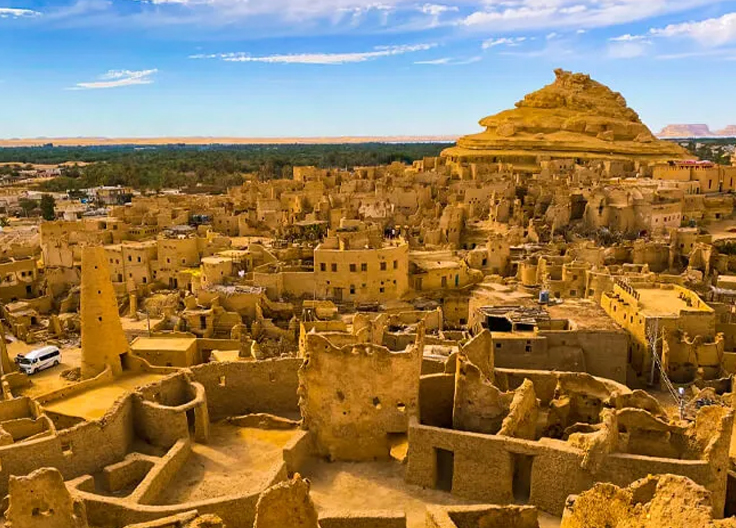
SIWA OASIS: The temple where the oracle of Amun confirmed Alexander the Great's divinity. 560 km from Cairo, near the Libyan border.
MEDINET HABU: The mortuary temple of Ramesses III, on the west bank of Luxor. Larger than Abu Simbel. Almost always empty of tourists.
ABYDOS OSIREION: The flooded granite structure behind Seti I's temple. Possibly older than any pyramid. No tourist signage.
IV. Akhenaten: the heretic pharaoh who invented monotheism
Amenhotep IV ascended the throne around 1353 BC and within a few years made a decision that shook the foundations of the most stable civilisation in history: he abolished the Egyptian pantheon, closed the temples, dissolved the powerful clergy of Amun and declared that a single true god existed — the solar disc Aten — whose sole earthly intermediary was himself. He changed his name to Akhenaten — 'the one who is useful to Aten' — and built from scratch a new capital in the desert, Akhetaten, known today as El-Amarna.
The art of his reign is radically different from everything that came before and after: elongated figures, exaggerated necks, prominent bellies, a sensuality and informality that clash with the hieratic rigidity of the Egyptian canon. The domestic scenes — Akhenaten and Nefertiti playing with their daughters beneath the rays of the sun-god — have no equivalent in any other period of ancient art history.
When he died, his successor — possibly his own son, the young Tutankhamun — restored the cult of Amun, closed the new city and began the process of erasing him from history. But some historians of religion advance an uncomfortable thesis: that Akhenaten's monotheism may have influenced, across the centuries and through the peoples who coexisted with the Egyptians, the development of Hebrew monotheism and, by extension, the three great Abrahamic religions. There is no definitive proof. There is, however, a temporal and geographical coincidence that it is impossible to ignore.
V. Living Egypt: what happens when the sun goes down
One of the most common errors of the traveller arriving in Egypt on a closed circuit is confusing the country with its monuments. The temples are extraordinary. But the Egypt that exists when the sun sets over the Nile and families bring their chairs out onto the street, when the shisha cafés fill with conversation and scented smoke, when the fuul and tamiya vendors set up their stalls on the corners and the smell of freshly baked bread mingles with the jasmine women carry in their hair — that Egypt does not appear in any monument guide.
The night markets of Luxor, on the east bank of the Nile, after eight in the evening are one of the richest human spectacles this country has to offer. The city of Aswan at dusk, walked on foot from the hotel to the spice market — cardamom, black cumin, dried hibiscus, henna powder — is a sensory experience that all five senses process simultaneously and that no photographic filter can do justice to.
And then there are the conversations. Egyptians have a tradition of hospitality that is not protocol: it is conviction. An invitation to sit in a merchant's shop with no expectation of purchase, a child practising English with a wide grin, an old man on the riverbank who points to the water and says something the guide translates as 'the Nile does not forget'. These are the moments travellers remember twenty years later, not the construction dates of the temples.
VI. What the slow traveller discovers
There is a paradox in luxury tourism that the best operators know well: the more one pays, the more time one has. Not because budget buys hours — that is not possible — but because a well-designed journey eliminates the friction that consumes real time: the waiting, the improvised transfers, the generic breakfasts, the queues. With that recovered time, the traveller can afford something that a ten-countries-in-twelve-days circuit makes impossible: to stop.
To stop in a courtyard of the Ibn Tulun Mosque, the oldest religious building in Cairo, dating from the 9th century, which has a geometric serenity that the great sacred spaces of the world share regardless of their tradition. To stop at the edge of an irrigation canal south of Luxor, where a young shepherd drives his goat flock exactly as depicted in the reliefs of the Old Kingdom. To stop before a sunset in the western desert, when the light is so low that the dunes cast shadows several metres long and the silence has, finally, all the space it needs.
That Egypt is not in the guidebooks because it cannot be described. It can only be lived.
— ✦ —
"The deepest Egypt is not visited. It is found. And it is only found when someone who truly knows it accompanies you to search for it."
To design a journey to Egypt that goes beyond the standard circuits, contact our team and we will build together an experience made entirely for you.