At Travel Center, we present a carefully curated selection of optional excursions designed to further enrich your experience in Egypt and offer a deeper, more exclusive and personalised insight into this unique destination. Each proposal has been selected with special attention to detail, combining history, culture, and authenticity, always with the highest level of comfort and service. These experiences allow you to go beyond the main itinerary, accessing exceptional sites, local traditions, and landscapes that reveal new dimensions of both the Pharaonic legacy and contemporary Egyptian life. From visits to iconic monuments to unique cultural encounters and immersive experiences, these optional excursions are designed for those who wish to experience the journey in a more complete, flexible, and enriching way.
Every stage of the journey has been thoughtfully crafted to ensure seamless comfort, effortless flow, and highly personalized service, delivering an unforgettable experience at the heart of both ancient and contemporary Egypt.
The Grand Egyptian Museum in Cairo (GEM), widely regarded as the most anticipated museum opening globally, has recently inaugurated its first phase after decades of planning and development, opening its initial 12 chronological galleries. These spaces showcase key pieces that narrate the history of one of the most fascinating civilizations of antiquity, spanning the Old Kingdom, Middle Kingdom, New Kingdom, and even the Greco-Roman period.
This initial opening, after more than 20 years of development and a major investment, represents a historic milestone, establishing the GEM as the new home of Tutankhamun’s treasures and positioning it among the most important museums in the world.
Often referred to as “the fourth pyramid” due to its scale and significance, the museum goes far beyond a traditional exhibition space, housing more than 100,000 artifacts and offering an immersive cultural experience. Its galleries feature cutting-edge multimedia presentations and virtual reality experiences that create a unique connection between past and present, showcasing Egypt’s archaeological and cultural richness in an innovative way.
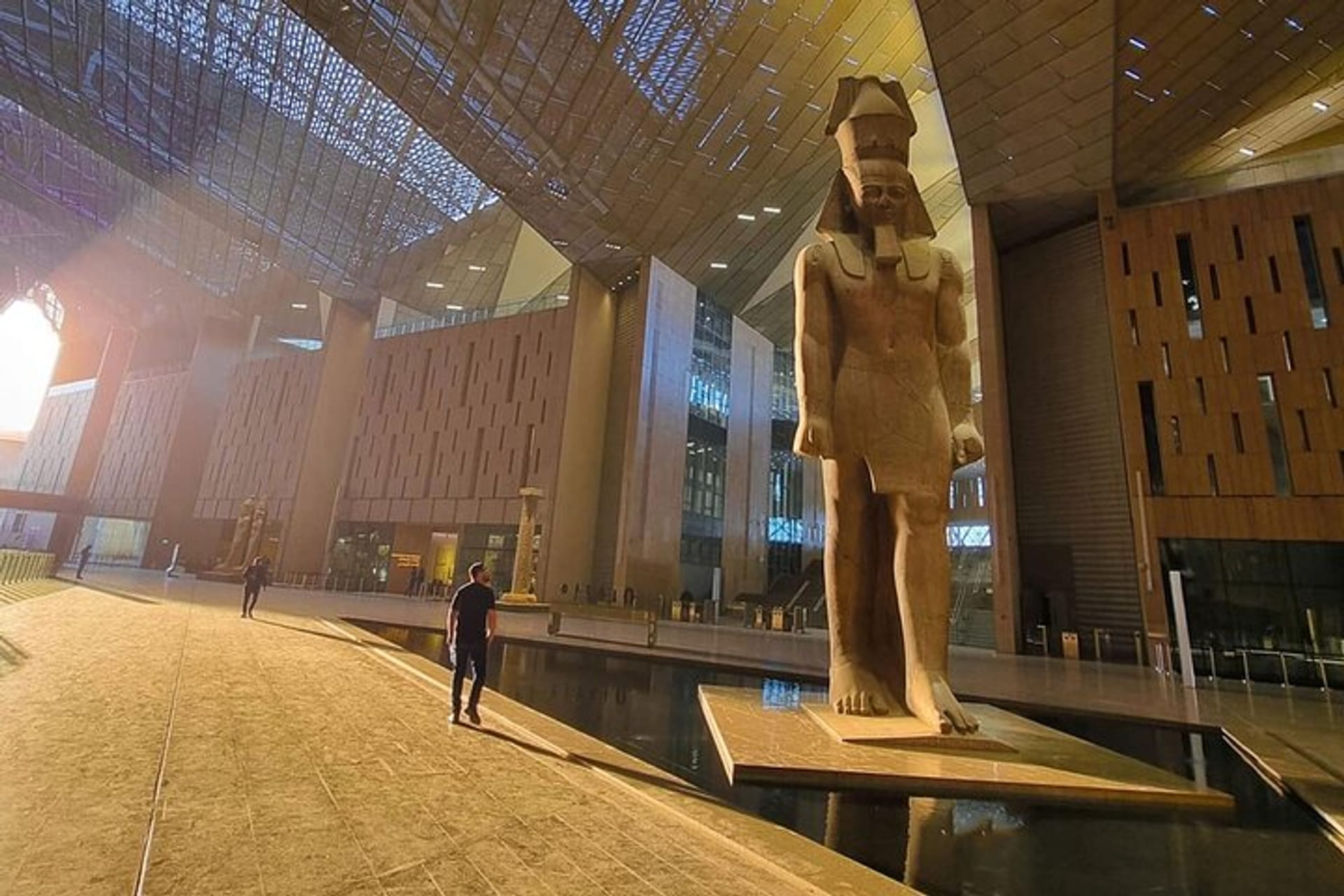
Access to the museum is through a vast plaza designed to evoke the feeling of standing before the Pyramids of Giza. Inside, visitors are greeted by the imposing statue of Ramses II, over 10 metres high, located in the main atrium. From the grand staircase, guests ascend to a viewing platform with a glass façade offering spectacular views of the exterior and surrounding historical wonders, reinforcing the museum’s deep connection with its iconic landscape.
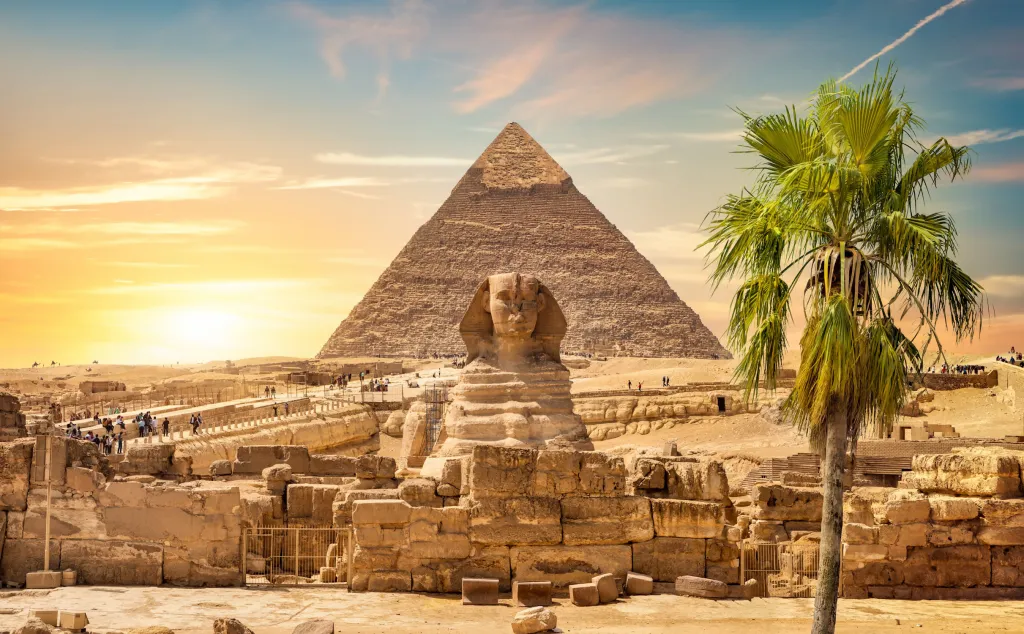
The visit includes the Bent Pyramid, one of the most unique constructions of the ancient world, easily recognisable by its unusual change in slope halfway up its structure. This architectural adjustment was made due to structural issues during construction, forcing a modification of the original angle and turning it into an exceptional testimony of the experimentation and learning process of ancient Egyptian engineers.
Next, visit the Red Pyramid, considered the first true pyramid of Ancient Egypt in terms of fully developed and stable design. Its name comes from the reddish tone that its limestone blocks acquire over time due to natural oxidation of the iron content in the stone, especially visible in the warm light of sunset, when the structure seems to glow over the desert landscape.
Access to its interior offers one of the most authentic and least crowded experiences of Pharaonic Egypt. Its corridors and chambers, simple in design yet of immense historical value, preserve a unique atmosphere where silence and depth create a powerful impression. Inside, the enclosed environment and the mineral composition of the stone may produce a characteristic scent associated with the antiquity of the materials and the natural oxidation processes of the surroundings.
Built in 1176 by Saladin as a defense against the Crusaders, it became one of the most important military strongholds in Cairo.
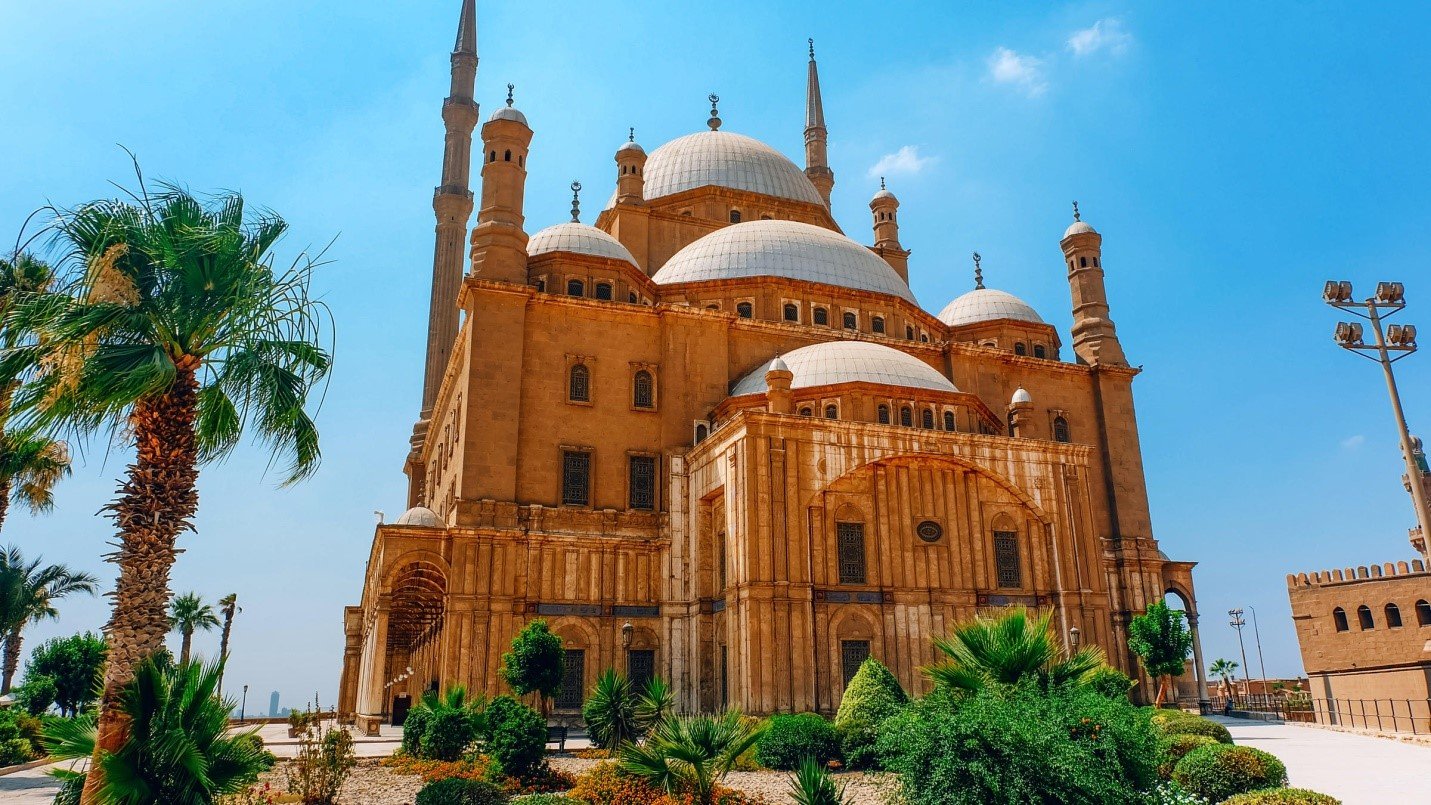
In 1805, Muhammad Ali took control of Egypt with the support of the Mamluks, former soldiers and mercenary officers who had held significant influence over the country’s power structure. During his rule, Muhammad Ali transformed the Citadel, building within its walls his royal residence known as the Palace of the Jewels, as well as the Mint, a prison, and his architectural masterpiece: the Mosque of Muhammad Ali, considered the crown jewel of more than 500 mosques in Islamic Cairo, distinguished by its Ottoman style and commanding presence over the city.
The Mosque of Al-Rifa’i is a majestic 19th-century Neo-Mamluk style monument, renowned for its elegance, soaring domes, and richly decorated interiors. Beyond its architectural and artistic value, it also houses the tombs of members of the Egyptian royal family, giving it significant historical and symbolic importance in the country’s modern history.
Directly opposite stands the Sultan Hassan Mosque–Madrasa, considered one of the masterpieces of Islamic medieval architecture. Built in the 14th century during the Mamluk period, it is striking for its monumental scale, massive stone walls, and vast central courtyard surrounded by four imposing iwans. Its design combines both a mosque and an Islamic school (madrasa), reflecting its dual spiritual and educational function.
Together, these two monuments offer a unique insight into the architectural splendour of Islamic Cairo, where art, history, and spirituality merge in an environment of exceptional beauty and heritage value.
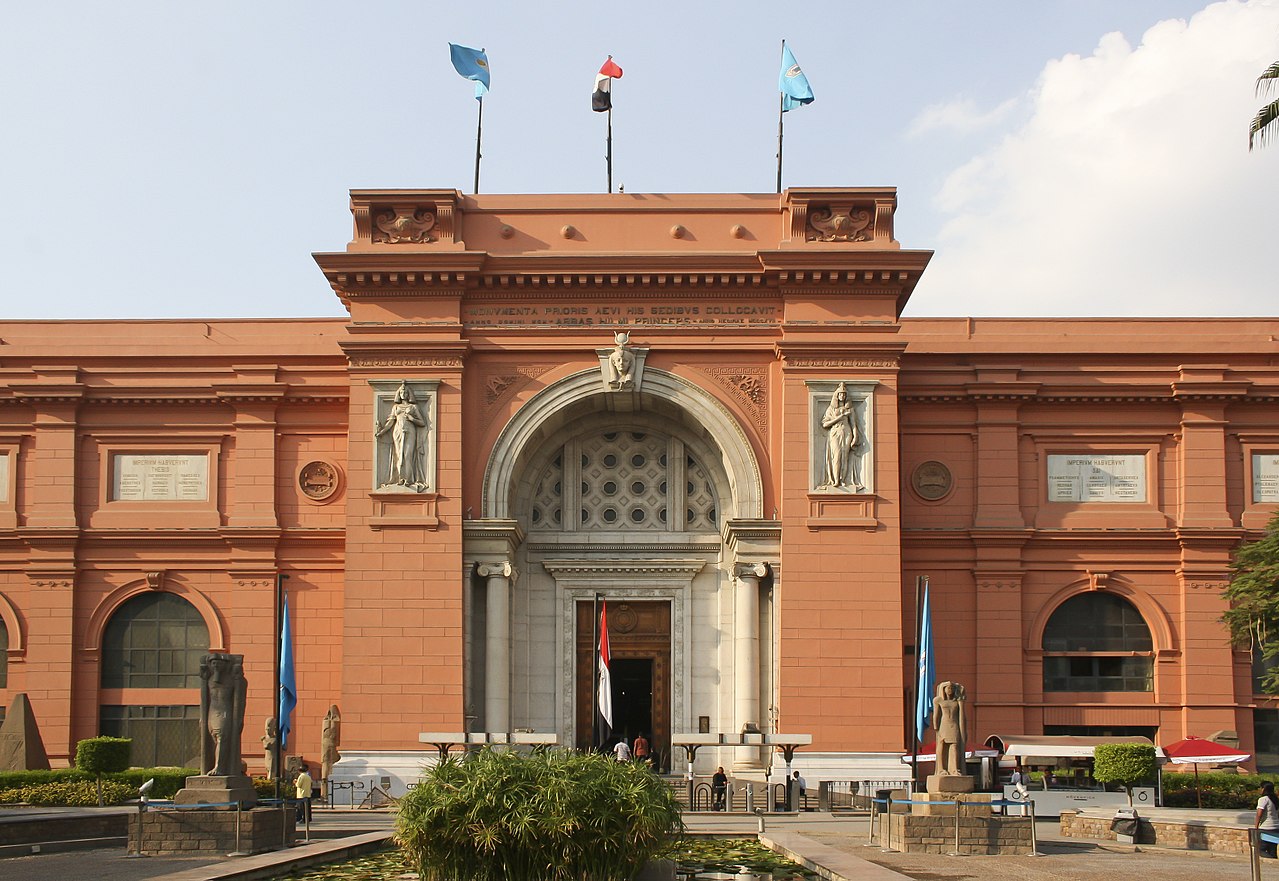
The museum houses the renowned Royal Mummies Gallery, one of its main highlights, where the remains of some of the most emblematic pharaohs of Ancient Egypt are displayed in a respectful and carefully preserved setting. This experience is designed to create a unique emotional and cultural connection with historical figures who shaped one of the most influential civilizations in human history.
Throughout the visit, guests discover artifacts from all historical periods: the Old, Middle, and New Kingdoms, as well as the Greco-Roman, Coptic, Islamic, and modern eras. The collection includes sculptures, sarcophagi, jewellery, papyri, ritual objects, everyday tools, and artistic pieces that reflect the social, political, religious, and cultural evolution of the country over time.
One of the museum’s greatest strengths is its ability to contextualize Egyptian history in a clear and immersive way, combining modern exhibition technology with a carefully structured narrative. This allows visitors not only to understand the key milestones of Pharaonic civilization but also to appreciate the cultural continuity that connects the ancient past with contemporary Egypt.
Strategically located between the Mediterranean Sea and Lake Mareotis, and facing the legendary island of Pharos, Alexandria has been, since antiquity, a key hub for trade, culture, and knowledge.
In its origins, the city was known as Rakotis, an Egyptian settlement that was later transformed and expanded into one of the most important cities of the ancient world. Its urban layout was designed by the Greek architect Dinocrates of Rhodes, under the vision of Alexander the Great, who ordered its foundation in 331 BC.
Alexandria was organized into five major districts, reflecting its cosmopolitan nature and the coexistence of Egyptian, Greek, and Roman cultures, all of which left a profound legacy shaping its unique historical identity.
This impressive column, approximately 27 meters high and 2.5 meters in diameter, is carved from a single block of red granite, reflecting the extraordinary technical and symbolic achievement of its construction. Its name is traditionally linked to the Roman general Gnaeus Pompeius Magnus, rival of Julius Caesar during Rome’s civil wars. According to legend, after his defeat, Pompey was killed in Egypt, and his head was presented to Caesar as an offering—an event mythically associated with this column, which today carries his name and a strong historical aura.
The Siwa Oasis is known for its peaceful atmosphere and isolation, making it an ideal destination for those seeking authenticity and direct contact with nature. Among its main highlights is the legendary Shali Fortress, built from salt-based mudbrick, which dominates the oasis landscape and reflects traditional Siwan architecture.
The destination also features sites of great historical and spiritual value, such as the Temple of the Oracle of Amun, where, according to tradition, Alexander the Great was proclaimed the son of the god Amun.
Visitors can also enjoy the famous natural saltwater pools, such as Cleopatra’s Pool, where it is possible to relax while floating in crystal-clear waters surrounded by an incomparable desert landscape.
The Siwa experience is completed with 4×4 excursions across the Great Sand Sea, visits to massive dunes, and spectacular sunsets over the desert, as well as encounters with the local culture, its traditions, and unique hospitality, including a Bedouin dinner.
An authentic, remote, and magical destination where nature, history, and culture come together to offer an unforgettable experience in the heart of the Egyptian desert.
The Bahariya Oasis, located around 370 km from Cairo (approximately a 4-hour drive), serves as the gateway to this fascinating region. Surrounded by palm groves, natural springs, and small villages, the oasis combines a peaceful atmosphere with historical remains and authentic local life. It is the ideal starting point for exploring some of the most spectacular desert formations in the country.
From here begins the journey into the Black Desert, named for its hills and mountains covered with dark volcanic rocks, creating a striking and dramatic landscape. Along the route, vast arid expanses are dotted with unique geological formations that reflect millions of years of natural evolution.
The experience continues towards the breathtaking White Desert, one of the most iconic landscapes in Egypt. This area is characterised by its surreal white limestone formations sculpted by the wind into extraordinary shapes, resembling an open-air natural museum. At sunset, the light transforms the scenery, painting the rocks in golden and pink tones, creating an unforgettable visual spectacle.
During the excursion, stops are often made at natural springs, outdoor meals are enjoyed, and in many cases the experience includes an overnight stay in the desert under an exceptionally clear starry sky.
This combination of oasis life, volcanic deserts, and surreal white landscapes makes the visit a complete adventure, ideal for those seeking nature, authenticity, and scenery unlike anywhere else in Egypt.
Visit to the magnificent rock-cut temples built by order of Pharaoh Ramses II, one of the greatest builders of Ancient Egypt, and dedicated both to his own legacy and to Queen Nefertari, one of his most beloved wives. The Great Temple, dominated by the colossal seated statues of Ramses II on its façade, conveys a powerful sense of grandeur and authority, designed as a symbol of his victory at the Battle of Kadesh and the consolidation of Egyptian power over Nubia.
Next to it stands the Temple of Nefertari, dedicated to the Great Royal Wife and the goddess Hathor, distinguished by its refined sculpture and exceptional symbolic value, as it is one of the very few examples in which a queen is granted a temple of equivalent importance to that of a pharaoh, reflecting her significance within the royal court and dynastic history.
One of the most extraordinary aspects of the complex is its complete relocation in the 1960s, when both temples were carefully dismantled into blocks and reassembled on an artificial hill to prevent their submersion following the construction of the Aswan High Dam. This operation, considered one of the greatest feats of archaeological engineering of the 20th century, saved this unique world heritage site, preserving its original solar alignment and symbolic value.
During the navigation, you pass through an extraordinary natural environment that resembles a National Geographic documentary: small Nile islands, rocky formations, native bird species such as the Nile chicken, and local wildlife including water buffalo along the riverbanks. Along the route, you also admire iconic landmarks of Aswan such as the remains of the First Cataract of the Nile, the Aga Khan Mausoleum, Elephantine Island, and the legendary Old Cataract Hotel, famously featured in Agatha Christie’s “Death on the Nile”.
Arrival at the Nubian village is made via a small riverside beach, where you can enjoy your first contact with the surroundings, relax, swim in the Nile, refresh, or even ride a camel along the riverbank in a truly unique natural setting.
You then visit the traditional Nubian village from the inside, discovering one of Egypt’s oldest and most distinctive cultures. The Nubian community, with its own identity, language, and traditions, is known for its brightly coloured houses decorated with symbolic motifs, creating an atmosphere full of art, hospitality, and life.
During the visit, you explore its peaceful streets, traditional architecture, and Nile-connected way of life. The experience includes a warm welcome from local families, who share their culture and gastronomy, offering traditional bread, honey, molasses, Egyptian nougat, goat cheese, mint tea, and shisha. You may also enjoy henna tattoos and see small crocodiles locally raised within the village.
The visit also includes a stop at a small local school where the Arabic and Nubian alphabets and numbers are taught, allowing visitors to write their names as a souvenir.
The excursion ends with a boat return at sunset, sailing back along the Nile as the golden light transforms the landscape into a scene of exceptional beauty and serenity.
Built during the 20th Dynasty (1183–1153 BC), the temple not only served a religious function dedicated to the god Amun and the pharaoh’s funerary cult, but also played a political, administrative, and defensive role. Its fortified complex included a royal palace, storage facilities, and chapels, reflecting its strategic importance during a transitional period of the New Kingdom.
Architecturally, Medinet Habu follows the classic layout of great Egyptian temples, with monumental pylons, vast open courtyards, hypostyle halls, and a central sanctuary. Its first great pylon leads to a courtyard featuring colossal statues of Ramses III and the god Osiris, followed by successive chambers richly decorated with remarkable artistic detail.
One of the most outstanding features of the temple is its extraordinary reliefs, covering more than 7,000 m² of decorated walls. These scenes depict historical battles against the Sea Peoples, religious rituals, processions, and episodes from the pharaoh’s life, with traces of their original polychrome still visible, allowing visitors to appreciate the vibrant colours of ancient times.
Beyond its funerary purpose, the temple was also an important religious and cultural centre, hosting festivals such as the Beautiful Feast of the Valley. Over time, it was partially used as a Coptic settlement during the Christian period.
Today, Medinet Habu is one of the best-preserved temples in Egypt, with much of its structure still standing and accessible to visitors. Its combination of monumentality, artistic richness, and historical significance makes it an essential visit to understand the grandeur of Pharaonic civilisation in Luxor.
The Temple of Dendera, located on the banks of the Nile north of Luxor, is dedicated to the goddess Hathor, deity of love, music, joy, and motherhood. The current complex was mainly built during the Ptolemaic and Roman periods, although it stands on earlier structures. It is renowned for its excellent state of preservation and its impressive hypostyle hall, whose columns are crowned with Hathoric capitals in the form of the goddess’s face. Inside, visitors can admire unique astronomical reliefs, such as the famous Dendera Zodiac, as well as ritual scenes depicting religious ceremonies, offerings, and sacred processions. The temple also includes underground crypts, terraces, and chapels, reflecting the complexity of its religious and symbolic function.
On the other hand, the Temple of Abydos, located further north in Upper Egypt, is one of the oldest and most sacred religious centres in the country. Mainly dedicated to the god Osiris, lord of the underworld and resurrection, Abydos was for centuries an important pilgrimage site. The most significant temple within the complex was built by Pharaoh Seti I and completed by Ramses II, and is considered a masterpiece of Egyptian architecture due to the quality and precision of its reliefs. Its walls contain the famous Abydos King List, a fundamental record listing many of Egypt’s pharaohs. Its hypostyle halls, sanctuaries, and finely detailed polychrome reliefs depict religious scenes of extraordinary artistry and refinement.
Together, both temples offer an exceptional insight into the spirituality of Ancient Egypt: Dendera reflects the cult of life, beauty, and divine harmony, while Abydos represents the connection with the afterlife and resurrection. Combined, they form an essential visit to fully understand the religious, artistic, and symbolic depth of the Pharaonic civilisation.